
 RoboParty
ROBOTO
RP1 is RoboParty’s open-source bipedal humanoid for research, education and robot development. It stands 1.35 m tall, weighs about 39 kg and has 24 active degrees of freedom. Standard equipment includes a locomotion head, dummy hands and an RK3588 computing module. It supports hot-swappable batteries and modular development.
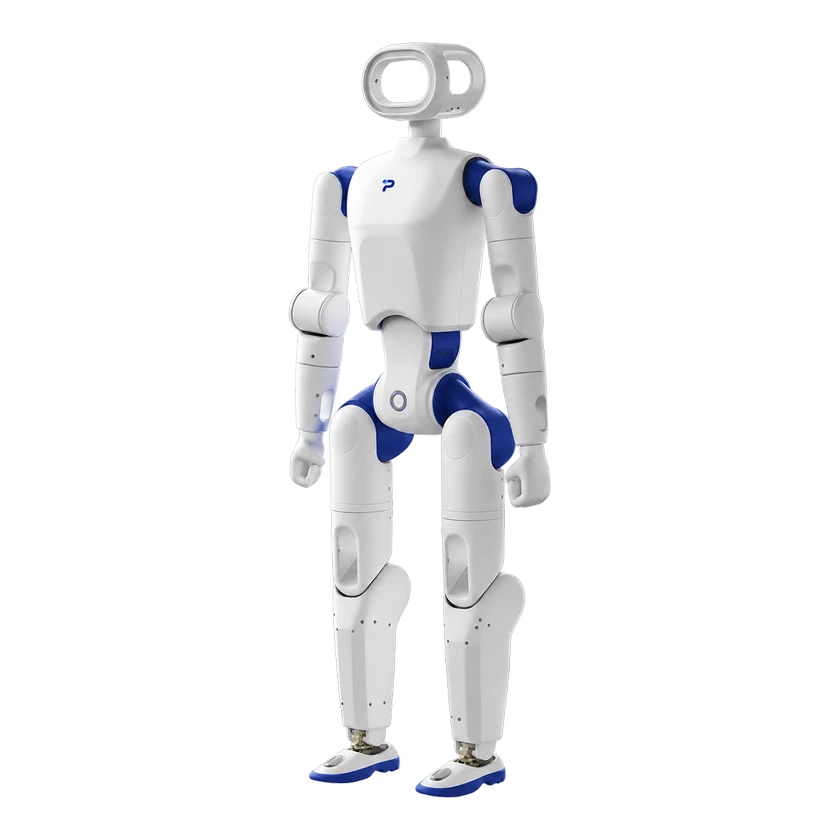
Hardware Specification
Physical Specifications
Mobility & Payload
Degrees of Freedom
Mechanical Structure
Sensors
Battery and Runtime
Compute Platform
Safety and Protection
Interaction and Communication
Development and Expansion
Development support
ROBOTO 01(RP1)Current model
Conditional accessExact existing RP1 record. Official series documentation maps RP1 to24 body joints and RP1 Pro to28 body joints plus2head joints; hand axes are counted separately. This batch covers the corresponding body development configuration only, conditional on matching delivered mechanical revision, LRO CAN-FD controller/firmware, IMU, host SDK ABI, calibrated zero/sign/bus-ID maps and closed-chain ankle conversion. Source pins: inference b3eaa0bb6a9d, motors a5c930a06a16, description8c12d13ae051. The current website and pinned source differ in API defaults, control periods and robot type labels; use one mutually compatible pinned stack and verify its actual contract. Preserves existing physical specifications, price/status and publication state; the two Pro records remain separate. No software/hardware executed.
ROBOTO Origin
Conditional accessExact existing RobotoOrigin/RPO prototype, not RP1/Pro variants. Pinned deploy95be3502 gitlinks fix inferenceb3eaa0bb and motorsa5c930a0, verified by Git tree without checking out/executing code. RPO reference configuration has23DMmotor slots across4CAN buses plus HIPNUCserialIMU, actualsign/offset/urdf2motor/closed-chain ankles; this does not overwrite physicalDOF. Match delivered motor models/firmware/USB-CAN/zeroing/config and built ROS2Humble-or-Jazzy workspace, one command owner. Parent aggregateGPL does not relicense submodules/binaries/assets; only scoped reviewed code grants apply.
Exact existing RP1 record. Official series documentation maps RP1 to24 body joints and RP1 Pro to28 body joints plus2head joints; hand axes are counted separately. This batch covers the corresponding body development configuration only, conditional on matching delivered mechanical revision, LRO CAN-FD controller/firmware, IMU, host SDK ABI, calibrated zero/sign/bus-ID maps and closed-chain ankle conversion. Source pins: inference b3eaa0bb6a9d, motors a5c930a06a16, description8c12d13ae051. The current website and pinned source differ in API defaults, control periods and robot type labels; use one mutually compatible pinned stack and verify its actual contract. Preserves existing physical specifications, price/status and publication state; the two Pro records remain separate. No software/hardware executed. Body position/hybrid interface: apply_action(p,v,kp,kd,tau), URDF-to-motor permutation and sign conversion, wrapped state and nearest-turn targets. Supply every position and gain entry; actual pinned validation requires finite kp>0 and kd>=0 for every motor. The website says optional gains default from configuration, but this pinned Python binding requires explicit p,v,kp,kd; only tau has a default. Position/velocity targets must match the 24-entry body layout; check finite values, limits and state freshness before invocation. CAN-FD batches use motorID-1 in8slots per bus. Parallel ankles convert desired joint PD+feedforward to actuator position targets with positive gains. This is position development, not an independent zero-kp velocity or pure torque mode. get_joint_tau is derived from get_motor_current; the pinned LRO feedback decodes CurMax amperes, so do not interpret it as measured jointNm or apply a torque-space inverse-transpose to raw current. No independent velocity/Nm/FF, Cartesian, navigation, teleoperation or persistent collection claim is added. Constructor opens hardware interfaces; init status does not aggregate per-driver success, refresh waits then reads cache.
Development capabilities
Sources · 4
- Officialroboparty.com ↗Verified: 2026-11-06
- Officialraw.githubusercontent.com ↗Verified: 2026-11-06
- Officialraw.githubusercontent.com ↗Verified: 2026-11-06
- Officialraw.githubusercontent.com ↗Verified: 2026-11-06
Open source & build resources
Software
Partially availableExamples or supporting tools are available; this does not establish access to the core system.
Hardware design
Not verifiedThere is not enough verified evidence to establish this dimension.
Build resources
Not verifiedThere is not enough verified evidence to establish this dimension.
| Type | Resource | License | Applicable version | Open |
|---|---|---|---|---|
| Code | roboparty_inference · scoped primary-code license GitHub · Roboparty/roboparty_inference Complete pinnedGPLv3 grant for primary roboparty_inference C++/pybind source, consistent with parent license inventory. Bundled ONNX/runtime libraries/checkpoints, NPZ/motion data/models and subdependencies remain separately scoped; no execution or whole-robot licensing claim. | GPL-3.0-only | rp1_24dof_cpp_body_b3eaa0bb, rp1_24dof_python_body_b3eaa0bb, rp1_24dof_ros2_documented_interfaces | Open GitHub |
Commercial Status
Related Entities
No related products recorded yet.
Timeline
- Robot releaseROBOTO 01(RP1)