
SoftHand Model-W
Exact research model with an integrated active wrist; not a qb SoftHand or a Pisa/IIT SoftHand.
SoftHand Model-W is a 3D-printed anthropomorphic underactuated research hand based on the Pisa/IIT SoftHand. It combines antagonistic finger tendons with a two-degree-of-freedom tendon-driven wrist. Carpal-tunnel-inspired routing places the actuators in the forearm. The paper evaluates disc rotation and cube stacking with and without wrist actuation.
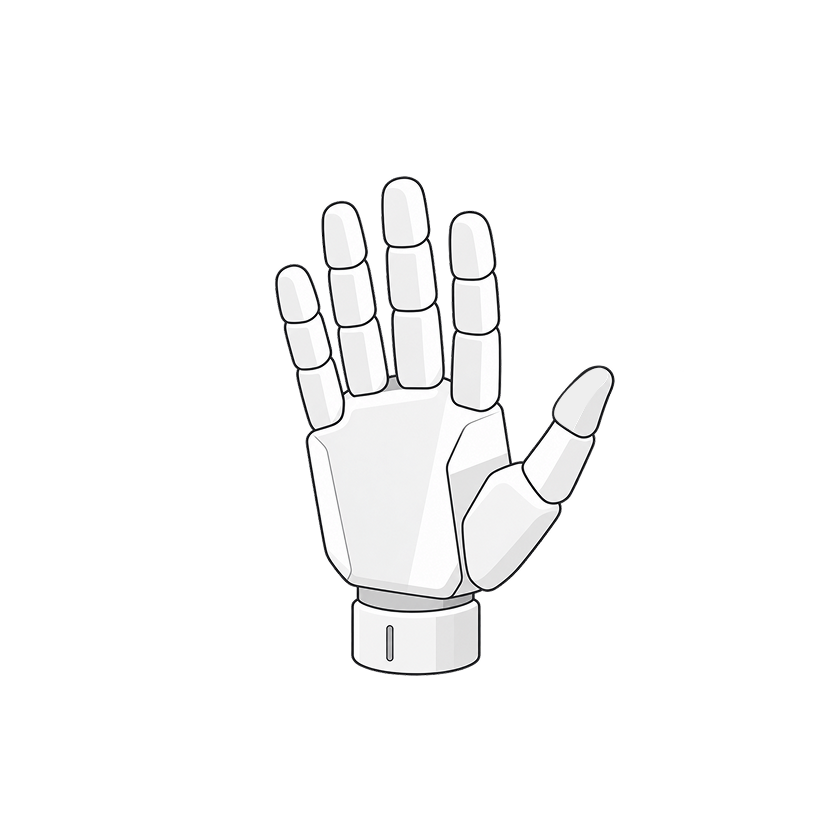
Technical specifications
Model specifications are shown below. Configuration-specific values are listed separately; missing data does not mean zero or unsupported.
Degrees of freedom and drive
Four is the combined actuation-channel count: two antagonistic finger drives and two wrist drives. It is not a per-hand independently controlled DoF count; the15 finger-joint motions are mechanically coupled.
Four is the combined actuation-channel count: two antagonistic finger drives and two wrist drives. It is not a per-hand independently controlled DoF count; the15 finger-joint motions are mechanically coupled.
Mechanical and mounting
Four is the combined actuation-channel count: two antagonistic finger drives and two wrist drives. It is not a per-hand independently controlled DoF count; the15 finger-joint motions are mechanically coupled.
164.6mm is palm base to middle fingertip, excluding wrist and forearm actuation box.
Mechanical Structure
Compute Platform
The open-loop proportional controller applies to the wrist. Finger opening/closing uses calibrated servo-position commands; no tactile-feedback controller is established.
Interaction and Communication
URT-1 is an external USB-to-servo-serial controller. The evidence does not establish a native palm USB socket or CAN/Ethernet hardware.