π₀.₅ ForceBench Prompt Fusion

Third-party fine-tune

ForceBench Prompt Fusion is a research adaptation of Physical Intelligence’s π₀.₅. It combines six-axis wrist force and torque with seven robot-state values before tokenization. The release contains eight task-specific simulation checkpoints for comparing force-aware manipulation.

View full model description

Papers & reports (1)

ForceBench: Benchmarking Force Integration for Robotic Manipulation

Paper available

arXiv: 2610.19604
Authors & affiliations (11)

Author order: Original order

  1. Xuan Han

    PKU-PI Lab, Peking University

  2. Zinuo Jin

    PKU-PI Lab, Peking University

  3. Tianlin Li

    PKU-PI Lab, Peking University

  4. Yunfan Lou

    National University of Singapore · PKU-PI Lab, Peking University

  5. Xin Liu

    PKU-PI Lab, Peking University

  6. Yuchen Xue

    PKU-PI Lab, Peking University

  7. Yuanpeng He

    PKU-PI Lab, Peking University

  8. Boxian Yao

    PKU-PI Lab, Peking University

  9. Shuhan Zhan

    PKU-PI Lab, Peking University

First published
2026-10-14
Latest paper revision
v1 · 2026-10-14
Venue
arXiv preprint

Covered model versions

Paper ↗PDF ↗

How to access and use

Public code resources
Public access
Model files
Public access

ForceBench manuscript results

Training / fine-tuning code

Access
Public access

Verified on · 2026-11-23

Code license
MIT

Model files

Model files
Weight SortAccessWeights licenseCommercial use
ConditionalTerms

SourceVerified on · 2026-11-23

Conditions

Use and redistribution are subject to the Gemma Terms of Use and the Gemma Prohibited Use Policy.

CoM SortAccessWeights licenseCommercial use
ConditionalTerms

SourceVerified on · 2026-11-23

Conditions

Use and redistribution are subject to the Gemma Terms of Use and the Gemma Prohibited Use Policy.

Faucet TurnAccessWeights licenseCommercial use
ConditionalTerms

SourceVerified on · 2026-11-23

Conditions

Use and redistribution are subject to the Gemma Terms of Use and the Gemma Prohibited Use Policy.

Faucet DirectionAccessWeights licenseCommercial use
ConditionalTerms

SourceVerified on · 2026-11-23

Conditions

Use and redistribution are subject to the Gemma Terms of Use and the Gemma Prohibited Use Policy.

Stove TurnAccessWeights licenseCommercial use
ConditionalTerms

SourceVerified on · 2026-11-23

Conditions

Use and redistribution are subject to the Gemma Terms of Use and the Gemma Prohibited Use Policy.

Stove PressAccessWeights licenseCommercial use
ConditionalTerms

SourceVerified on · 2026-11-23

Conditions

Use and redistribution are subject to the Gemma Terms of Use and the Gemma Prohibited Use Policy.

Drawer PullAccessWeights licenseCommercial use
ConditionalTerms

SourceVerified on · 2026-11-23

Conditions

Use and redistribution are subject to the Gemma Terms of Use and the Gemma Prohibited Use Policy.

Nut ThreadAccessWeights licenseCommercial use
ConditionalTerms

SourceVerified on · 2026-11-23

Conditions

Use and redistribution are subject to the Gemma Terms of Use and the Gemma Prohibited Use Policy.

Release information

SourceVerified on · 2026-11-23

Checks before deployment

The checkpoint scores come from manuscript Table I and the authors’ paired evaluation records. The public loader rejects the archived weights without their matching runtime identity. The Franka Research 3 study used separately trained policies. Downloaded files and a small set of parameter arrays were spot-checked. Full-package verification and end-to-end policy inference remain unconfirmed. Available weights or code do not establish plug-and-play robot compatibility. Check the required configuration, data and interfaces in the source documentation.

Deployment and usage resources

Inference mode
Closed-loop simulation at 15 Hz control and 60 Hz physics, with a 50-step action chunk.
Dataset format
LeRobot demonstration episodes
Fine-tuning requirements
Simulation manuscript setup: 200 demonstrations per task, 10,000 updates, batch size 32.
Deployment requirements
Matching frozen runtime and configuration, original PaliGemma tokenizer and task normalization.

Architecture and inputs / outputs

Model type
Action policy
Architecture
VLA
Backbone
PaliGemma/Gemma
Action generation
Flow matching
Input
Language / RGB images / Robot state
Output
7-dimensional actions
Released
November 24, 2026

Scope and training

Base model

Physical Intelligence π₀.₅ (pi05_base)

Embodiment scope

Single embodiment

Functional purpose

action_control

Record identity

Third-party fine-tune

Output

Actions

Pipeline task

robotics

Prediction output

50 continuous actions per policy query

Robot form

Robotic arm

Task scope

Single task

Training data scale

200 demonstrations per simulation task

Training

Imitation learning / Supervised fine-tuning

Lineage

Fine-tuned from: π₀ · π₀.₅ ↗

Related robots

Evaluation results

No verified independent benchmark results are recorded for this version or the selected weights.

Full parameters and verification notes (model card)

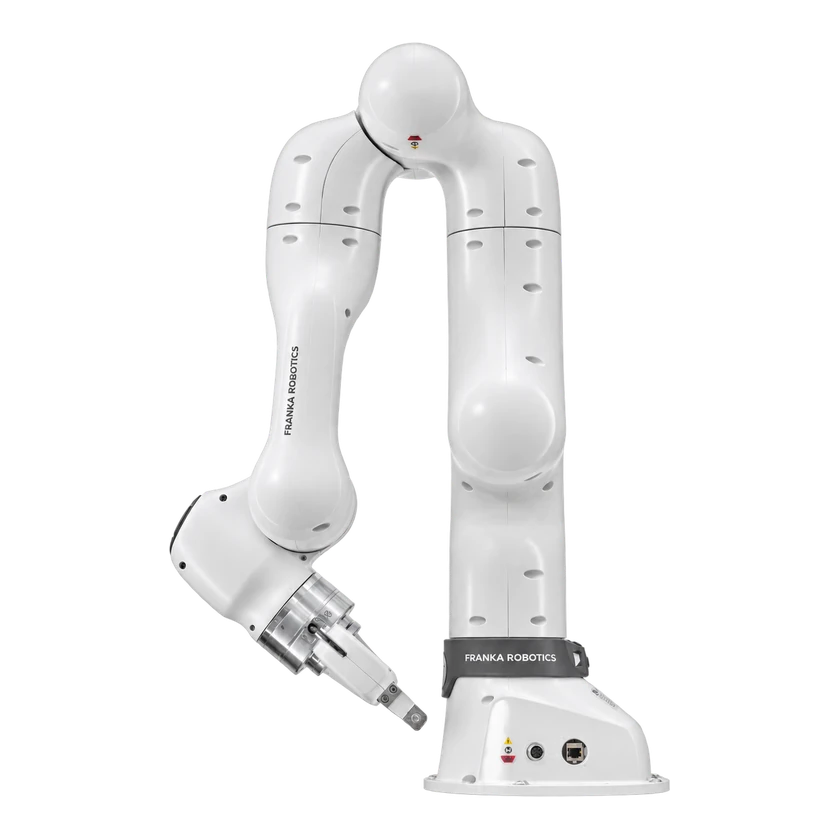
Each simulation task used 200 demonstrations and 200 evaluation episodes (seeds 300–499). Simulation ran at 15 Hz control and 60 Hz physics. The manuscript reports 35.31% mean success for Prompt Fusion and 23.25% for the no-force baseline. The separate Franka Research 3 study trained its own policies for five tasks and reported 63.00% against 40.00%, with 20 trials per task and method. The public releases contain the simulation checkpoints.

The checkpoint scores come from manuscript Table I and the authors’ paired evaluation records. The public loader rejects the archived weights without their matching runtime identity. The Franka Research 3 study used separately trained policies. Downloaded files and a small set of parameter arrays were spot-checked. Full-package verification and end-to-end policy inference remain unconfirmed.

Submit a source or correction