
Embodied Interaction Policy: A Unified Model for Full-Duplex Human-Robot Interaction
논문 있음
arXiv: 2611.27327DOI: 10.48550/arxiv.2611.27327
저자 및 소속 (7)
저자 순서: 원문 순서
- 최초 공개
- 2026-11-23
- 최신 논문 개정
- v1
- 학회 / 학술지
- 미제공
EIP is a unified streaming policy for full-duplex human–robot interaction. It processes incoming audio and robot state to generate synchronized speech and motion, with emotion-aware gestures, proactive responses to sounds, and recovery from interruptions. The authors demonstrated it on Astribot S1.
전체 모델 설명 보기Full-duplex human–robot dialogue and speech-synchronized gestures.
논문 있음
저자 순서: 원문 순서
확인 날짜 · 2026-11-23
확인 날짜 · 2026-11-23
출처확인 날짜 · 2026-11-23
The official repository supplies training and offline inference code under Apache-2.0. Standalone WAV inference requires the upstream AIM base weights, an EIP Stage II checkpoint and an input WAV. Training also requires the data. The authors validated the system on Astribot S1. 가중치나 코드가 공개되어도 로봇에서 즉시 실행할 수 있다는 의미는 아닙니다. 문서에서 구성, 데이터 및 인터페이스 요구 사항을 확인하세요.
Apache-2.0
공식
행동
Synchronized 24 kHz speech and 30 Hz robot motion, 12 motion frames per chunk.
휴머노이드
지도 미세조정
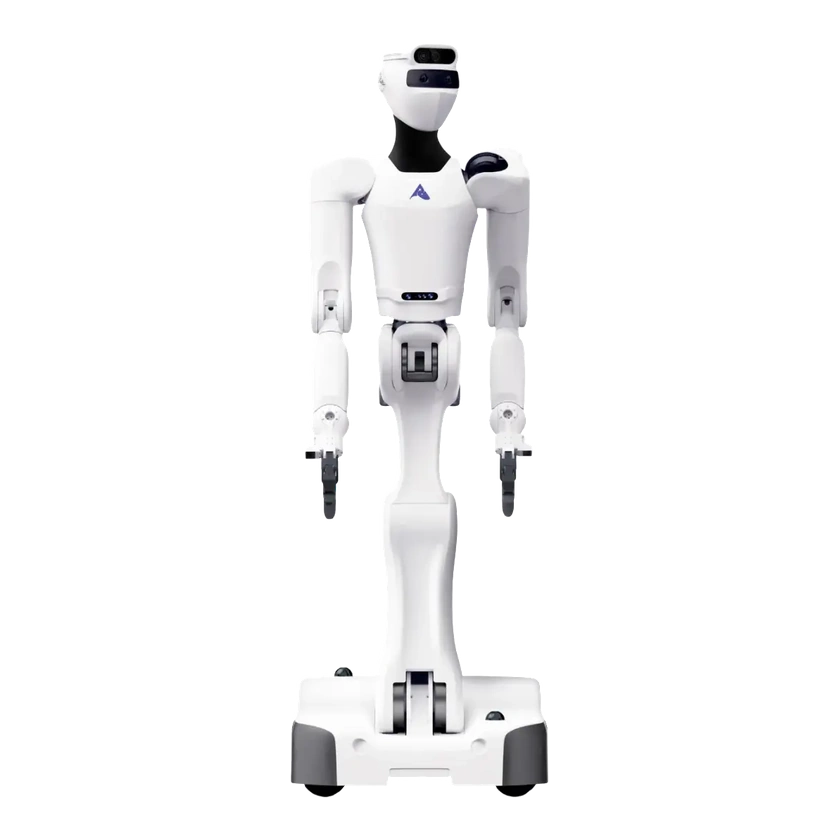
휴머노이드 로봇
The paper demonstrates emotion-aware gestures, proactive sound responses and interruption handling.
30 Hz motion in 400 ms chunks; 50 Hz commands after trajectory filtering.
The frozen Audio-Interaction backbone is based on Qwen2.5-3B. Its motion expert has about 380 million parameters across 36 Transformer blocks, with 16 heads, a hidden size of 768 and an intermediate size of 3,072. The two experts share a 400 ms clock. Audio input is 16 kHz; speech output is 24 kHz. Motion is generated at 30 Hz, 12 frames per chunk, with 20 actuated upper-body joints for Astribot S1 and 165 dimensions for the SMPL-X representation. S1 output covers four torso joints, two head joints and seven joints per arm. Chassis and gripper joints are outside that prediction.
The authors trained in two stages on eight NVIDIA RTX A6000 GPUs. Stage I ran for 15,000 steps and Stage II for 1,000. EI-Data combines BEAT2, GUAVA, SHOW and Seamless Interaction into about 60,000 twenty-second episodes.
The physical S1 demonstration used an RTX 5090 for online inference and issued trajectory commands at 50 Hz after filtering. In the separate RTX A6000 evaluation, human evaluators scored 20 AI-generated speech samples per scenario. Success was 90% for proactive response, 90% for interruption handling and 95% for emotion-aware motion. Table 4 reports a 91.7% average success rate, 1.35 s warm-start latency and a 0.804 real-time factor.