Embodied Interaction Policy (EIP)

Außerhalb des Hauptkatalogs

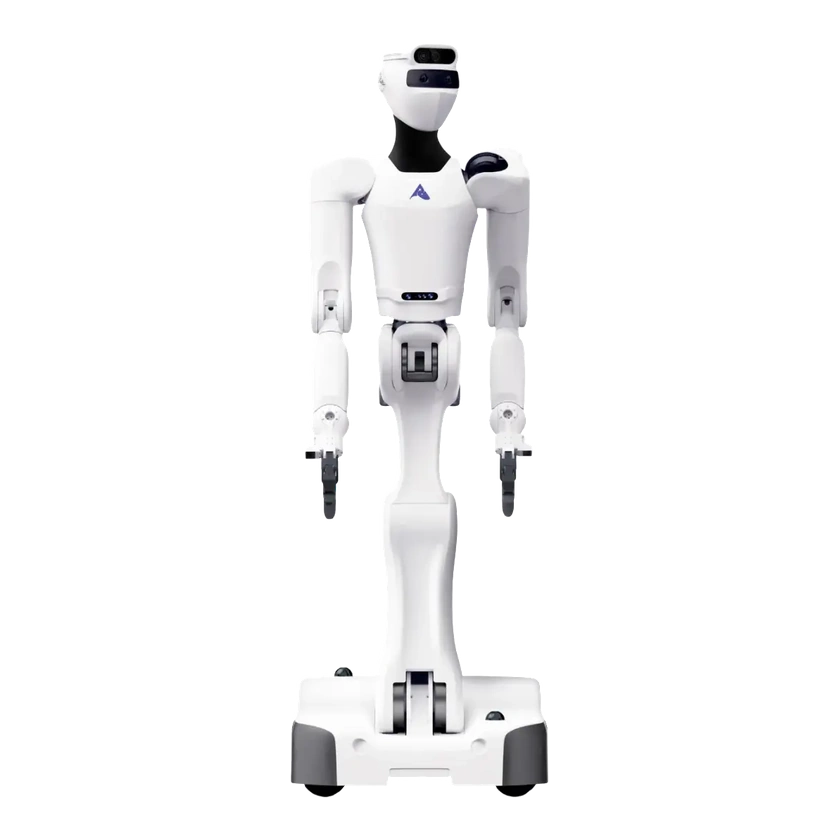
EIP is a unified streaming policy for full-duplex human–robot interaction. It processes incoming audio and robot state to generate synchronized speech and motion, with emotion-aware gestures, proactive responses to sounds, and recovery from interruptions. The authors demonstrated it on Astribot S1.

Vollständige Modellbeschreibung ansehen

Full-duplex human–robot dialogue and speech-synchronized gestures.

Publikationen (1)

Embodied Interaction Policy: A Unified Model for Full-Duplex Human-Robot Interaction

Fachartikel verfügbar

arXiv: 2611.27327DOI: 10.48550/arxiv.2611.27327
Autoren und Einrichtungen (7)

Autorenreihenfolge: Originalreihenfolge

  1. Youqiang Gui

    Sichuan University · International Digital Economy Academy (IDEA)

  2. Yunfei Liu

    International Digital Economy Academy (IDEA)

  3. Lijian Lin

    International Digital Economy Academy (IDEA)

  4. Ye Zhu

    International Digital Economy Academy (IDEA)

  5. Jianan Wang

    Astribot

  6. Cheng Peng

    Sichuan University

  7. Yu Li

    International Digital Economy Academy (IDEA)

Erstveröffentlichung
2026-11-23
Neueste Revision
v1
Konferenz / Zeitschrift
Nicht angegeben

Abgedeckte Modellversionen

Zugang und Nutzung

Öffentliche Code-Ressourcen
Öffentlicher Zugang

Code und Training / Fine-Tuning

Zugang
Öffentlicher Zugang

Geprüft am · 2026-11-23

Code-Lizenz
Apache-2.0

Geprüft am · 2026-11-23

Veröffentlichungsangaben

QuelleGeprüft am · 2026-11-23

Vor der Bereitstellung prüfen

The official repository supplies training and offline inference code under Apache-2.0. Standalone WAV inference requires the upstream AIM base weights, an EIP Stage II checkpoint and an input WAV. Training also requires the data. The authors validated the system on Astribot S1. Verfügbare Gewichte oder Code belegen keine sofortige Roboterkompatibilität. Prüfen Sie Konfiguration, Daten und Schnittstellen in der Quelldokumentation.

Unterlagen zu Bereitstellung und Nutzung

Inferenzmodus
Full-duplex streaming uses 16 kHz audio, robot state and dialogue context in 400 ms chunks. Offline WAV inference is supported.
Datenformat
EI-Data: about 60,000 twenty-second episodes with speaking, listening and idle labels.
Laufzeit und Frameworks
PyTorch
Anforderungen an die Feinabstimmung
Stage II starts from the Stage-I checkpoint and trains emotion conditioning for 1,000 steps.
Bereitstellungsanforderungen
Physical Astribot S1 demo: NVIDIA RTX 5090 for online inference, with filtered trajectory commands at 50 Hz.

Architektur und Ein-/Ausgaben

Modelltyp
Aktionspolicy
Architektur
Transformer
Backbone
Frozen Audio-Interaction (Qwen2.5-3B)
Aktionsgenerierung
Flow Matching
Eingabe
Roboterzustand
Ausgabe
Astribot S1: 20 actuated upper-body joints (4 torso, 2 head, 7 per arm); chassis and grippers excluded. SMPL-X representation: 165 dimensions.
  • Aktionsgenerierung · Backbone · Eingabemodalitäten · Ausgabeaktionsraum · Hauptkategorie · Architektur: EIP preprint v1, full text

Einsatzbereich und Training

Code-Lizenz

Apache-2.0

Implementierungsquelle

Offiziell

Ausgabe

Aktionen

Vorhersageausgabe

Synchronized 24 kHz speech and 30 Hz robot motion, 12 motion frames per chunk.

Roboterform

Humanoid

Training

Überwachtes Fine-Tuning

Verwandte Roboter

Alle Parameter und Prüfhinweise (Modellkarte)

The frozen Audio-Interaction backbone is based on Qwen2.5-3B. Its motion expert has about 380 million parameters across 36 Transformer blocks, with 16 heads, a hidden size of 768 and an intermediate size of 3,072. The two experts share a 400 ms clock. Audio input is 16 kHz; speech output is 24 kHz. Motion is generated at 30 Hz, 12 frames per chunk, with 20 actuated upper-body joints for Astribot S1 and 165 dimensions for the SMPL-X representation. S1 output covers four torso joints, two head joints and seven joints per arm. Chassis and gripper joints are outside that prediction.

The authors trained in two stages on eight NVIDIA RTX A6000 GPUs. Stage I ran for 15,000 steps and Stage II for 1,000. EI-Data combines BEAT2, GUAVA, SHOW and Seamless Interaction into about 60,000 twenty-second episodes.

The physical S1 demonstration used an RTX 5090 for online inference and issued trajectory commands at 50 Hz after filtering. In the separate RTX A6000 evaluation, human evaluators scored 20 AI-generated speech samples per scenario. Success was 90% for proactive response, 90% for interruption handling and 95% for emotion-aware motion. Table 4 reports a 91.7% average success rate, 1.35 s warm-start latency and a 0.804 real-time factor.

Quelle oder Korrektur einreichen