
LernansatzOffizielle Angabe
Teleoperation
 Petoi
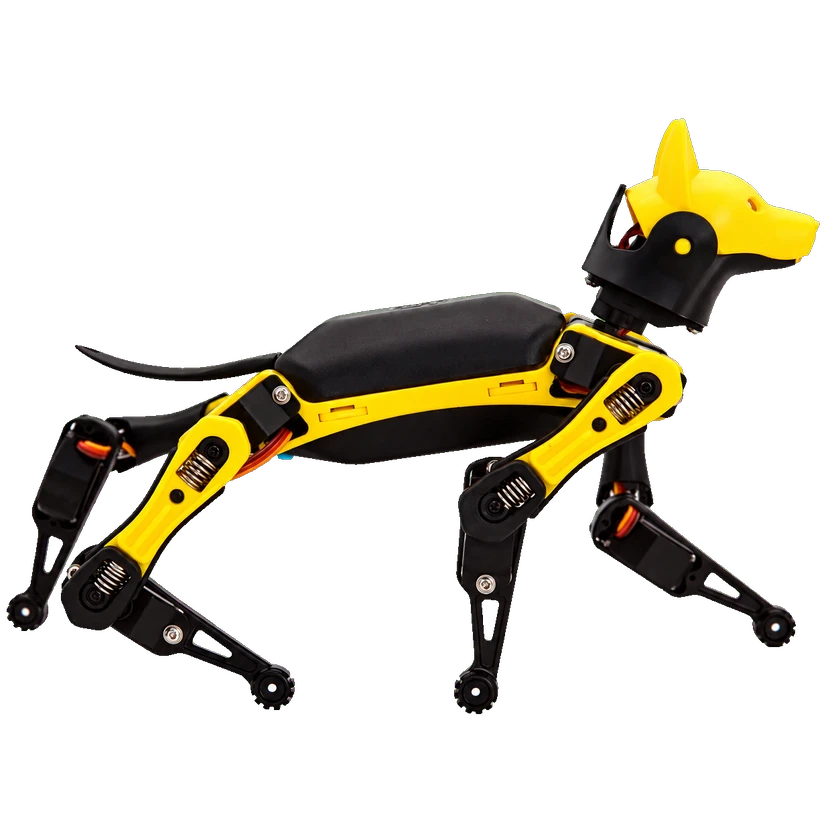
Bittle ist der handtellergroße vierbeinige Roboterhund von Petoi für Hobbyanwender, Schüler und Lehrkräfte. Seine neun Digitalservo-Gelenke und das Open-Source-System OpenCat unterstützen Blockprogrammierung, Python, Arduino und App-Steuerung für Gehen, Laufen, Tricks und das Lernen von Robotik.
Versuche bedeuten keine Serienausstattung. Belege gelten nur für die genannte Modellversion.
Petoi describes Bittle as a four-legged robot dog and states that its battery supports about one hour of continuous walking.
The official Bittle FAQ states that the robot processes voice commands locally and does not send voice to a server.
Petoi describes 35+ lifelike interactive movements, remote or app control, and use in team coding and social-interaction learning.
Bittle has model-scoped manufacturer programming documentation and serial Python/C++ interfaces. This is the legacy NyBoard model, using the NyBoard OpenCat build; the newer ESP32 Nybble Q/Bittle X V2 hardware is separate. Match the delivered board revision, servo variant, firmware model/calibration and host library. The reviewed body is the standard quadruped without an optional manipulation-arm add-on; legs are not counted as execution arms. Open source firmware/API code does not by itself license all hardware, dependencies or hosted assets.
Bittle X V2 has model-scoped manufacturer programming documentation and serial Python/C++ interfaces. The current guide explicitly identifies this V2 model with BiBoard V1/ESP32; legacy docs explicitly exclude Bittle X V2. Match the delivered board revision, servo variant, firmware model/calibration and host library. The reviewed body is the standard quadruped without an optional manipulation-arm add-on; legs are not counted as execution arms. Open source firmware/API code does not by itself license all hardware, dependencies or hosted assets.
Bittle X V2+Arm has model-scoped manufacturer programming documentation and serial Python/C++ interfaces. The current guide explicitly identifies this V2 model with BiBoard V1/ESP32; legacy docs explicitly exclude Bittle X V2. Match the delivered board revision, servo variant, firmware model/calibration and host library. The reviewed body is a quadruped with one attached execution arm/gripper. Open source firmware/API code does not by itself license all hardware, dependencies or hosted assets.
Use the model-specific board firmware: NyBoard/ATmega328P, selecting the actual Bittle or Nybble model; NyBoard revisions may require different serial baud rates. Manufacturer Python docs specify Python>=3.6 and pyserial3.5; use the dependency versions of the matching checkout. The C++ CMake serial client exposes joint sequences/simultaneous targets, while Python m/M use calibrated degree targets and ASCII/binary framing. Configure actual port, power, servo offsets and active-index map: the logical16-slot packet is not16physical actuators. Native serial motion does not establish joint-velocity/torque/FF or map-navigation APIs. Distinguish commanded angle reporting from actual feedback; ESP32 f-feedback requires supported servo hardware.
Quellcode und Open-Source-Lizenz sind verifiziert. Beachten Sie die jeweiligen Lizenzbedingungen.
Logikdiagramm, Bauteile und Schnittstellen des NyBoard V1.0 für entsprechend ausgestattete Kits. Vollständige Fertigungsdaten und Hardware-Lizenzen sind nicht verifiziert.
Erläuterung ansehenOffizielle bebilderte Montageanleitung mit Videos für den Bittle-Bausatz. Kit-Teile erforderlich; eine vollständige unabhängige Beschaffungsliste und Fertigungsdaten sind nicht verifiziert.
Erläuterung ansehenOpenCat-Quadruped-Robot · pinned MIT primary software files
CodeGültige Version: petoi_bittle_native_serialMIT
opencat_serial_cpp · pinned MIT primary software files
CodeGültige Version: petoi_bittle_native_serialMIT
ros_opencat · pinned MIT primary software files
CodeGültige Version: petoi_bittle_ros1_noetic_85962928MIT
ros_opencat ROS2 branch · pinned MIT code
CodeGültige Version: petoi_bittle_ros2_bdec9d34MIT
OpenCat-Firmware (NyBoard)
CodeMIT
NyBoard V1.0 Controller-Schnittstellen
Hardware
Petoi Desktop App: Einrichtung und Kalibrierung
Werkzeug
OpenCat Python-Anleitung zur seriellen Steuerung
Anleitung
Statusangaben stammen aus früheren Berichten; der weitere Betrieb ist unbekannt.
Einsatzberichte 1 · Pilot 1 · Stückzahl im Projekt · Nicht bekannt
Bluefield State University
Petoi reports that its exact Bittle quadruped was featured in the inaugural one-week President’s Emerging Scholars Academy program at Bluefield State University. Students assembled the robots, used Scratch block-based coding, and programmed movement behaviors. Petoi says the academy began in summer 2023; WVVA’s June 19, 2023 report independently confirms that the academy launched that year and its students built robotic dogs on campus. The exact camp start day, robot count, payment, and current use are not disclosed.
Noch keine verwandten Produkte erfasst.

