

Price
Price not disclosed
Type
Robot Data Collection Systems
Status
Commercial
Availability
On sale
Purchase
Release Date
Unknown
Country/Region
India
Wearable first-person capture kit
Device form factor
RGB video
Captured data
Wearable recording without a robot
Robot required during capture
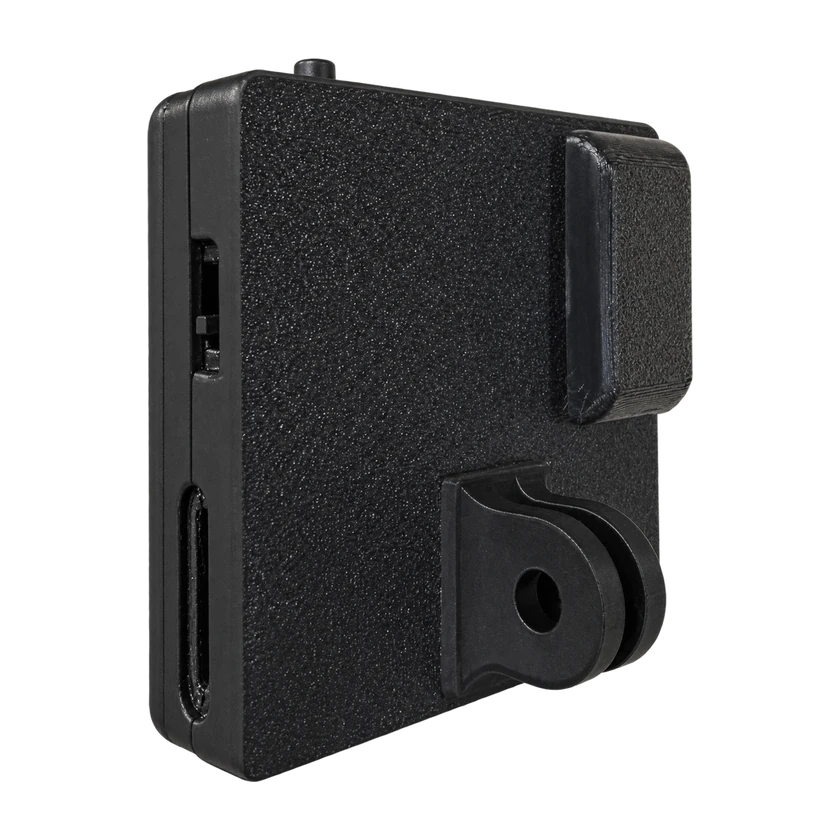
Trinet Wrist Kit captures head and both wrist views on one timeline for bimanual demonstrations. It mixes Mono, Stereo and Stereo GS cameras, with a separately sold wireless beacon on each camera. The cameras start together and record to separate cards. The manufacturer specifies a typical camera-to-camera offset below 1 ms. The main photo shows one camera with its beacon.
Technical specifications
Collection capabilities
Collection method
Human demonstration
Captured data
RGB video
Captured data
Inertial data
Captured data
Stereo audio
External compute required
Standalone recording; computer for toolkit processing
Device form factor
Wearable first-person capture kit
Robot required during capture
Wearable recording without a robot
Setup and calibration
Calibration requirements
Stereo/GS calibrated per unit; Mono uses reference calibration with per-unit service on request
Data streams
Per camera: MP4, VTS and IMU, grouped by grp. Kit metadata: Mono JSON, Stereo/GS VTS
Known limitations
Sync accuracy can drop during initial lock (1–2 s) or brief radio interruptions
Offline capture
Per-camera microSD recording
Sensing and data flow
Synchronization
Short-range radio beacons and shared kit clock
Software and export
Raw data access
Per-camera files on microSD
Wireless connection
One separately sold sync beacon per camera; Bluetooth status from firmware 0.5.9
Wireless connection
Android Bluetooth LE status only, SDK 0.5.3+ and camera firmware 0.5.9+
Software and export
Export file formats
MCAP per mono or stereo camera recording
Export file formats
LeRobot dataset after Studio annotation
Export file formats
JSON annotations from Studio
Export file formats
Parquet annotations from Studio
Record and replay
Synchronized side-by-side kit playback and validation
Identity and classification
Capabilities
On-card recording
Record scope
Capture system
Versions and commercial status
Development stage
Commercial product
Public contact link
Request a quote
Use cases and capture workflow
Recording start and stop markers
Physical button on any camera
Physical specifications and power
Mounting or wearing method
Head and wrist mounts included
Sensors, sampling and transmission
Synchronized capture from both hands
Synchronized left and right wrist cameras
Capture modes
Linked start/stop with separate card files and H.264/H.265 video
Timestamp support
Shared kit clock; manufacturer typically specifies under 1 ms between cameras
Timestamp support
Vendor LED test: 56 µs median head-to-wrist, 49 µs mean between wrists
Software, export and openness
Companion software
Trinet-tools for kit replay, sync checks and MCAP conversion for Foxglove and ROS 2
Companion software
Trinet Studio exports the entire kit recording as one MCAP in a desktop browser, without audio
Calibration data export
Calibration embedded in recording and carried into MCAP
Firmware versions and updates
Firmware 0.5.9 for Bluetooth monitoring, 0.5.16 for card encryption and new exposure controls
License and usage terms
Trinet-tools (MIT)
License and usage terms
Trinet-SDK (MIT)
SDK versions and download links
Android App/SDK 0.5.7 (new features require firmware 0.5.16)
SDK versions and download links
iOS SDK 0.3.5 (repository v0.5.4), iOS 17 or later
SDK versions and download links
iPhone USB mode: Mono V4 supported; Stereo/GS require firmware 0.5.13 or later
First-person and visual capture
Audio capture configuration
Stereo AAC per camera; 44.1 kHz on Stereo/GS, 48 kHz by default on Mono
Camera layout and count
Head and both wrists; Mono, Stereo and Stereo GS can be mixed
Camera shutter type
Mono and Stereo: rolling shutter; Stereo GS: global shutter
IMU configuration
Per camera: 400 Hz accelerometer and gyroscope, about 100 Hz magnetometer
RGB capture modes
1080p per view, about 29.7 fps in a kit and 30 fps standalone
Electrical and integration
Operating voltage
5 V
Battery and Runtime
Power Supply
USB-C power per camera
Commercial Status
Status
Commercial
Price
Price not disclosed
Release Date
Unknown
Related Entities
No related products recorded yet.
Submit a source or correction