

Price
Price not disclosed
Type
Robot Data Collection Systems
Status
Commercial
Availability
Not disclosed
Purchase
Release Date
Unknown
Country/Region
India
First-person wearable camera
Device form factor
RGB video
Captured data
Standalone human capture
Robot required during capture
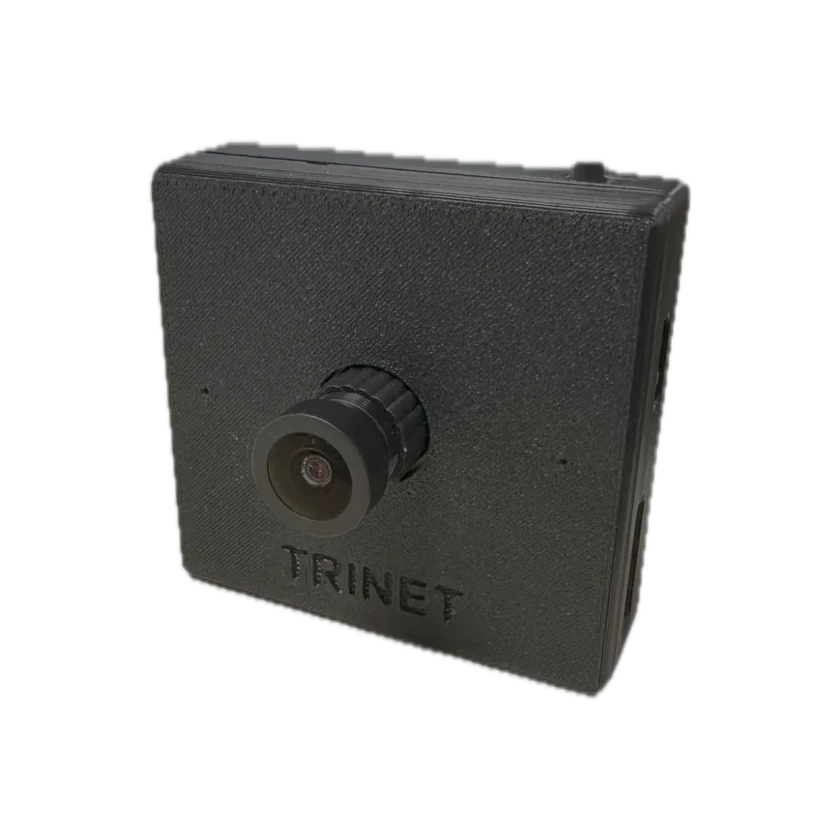
Trinet Mono is a wearable monocular camera for first-person data capture. The V4 hardware uses a shared clock for 1080p video, nine-axis motion data and stereo audio. It records to a memory card or streams over USB. Reference calibration is supplied, and Trinet-tools exports recordings to MCAP.
Technical specifications
Collection capabilities
Collection method
Human demonstrations
Captured data
RGB video
Captured data
Inertial data
Captured data
Stereo audio
External compute required
Standalone card recording; USB streaming uses a host
Device form factor
First-person wearable camera
Robot required during capture
Standalone human capture
Setup and calibration
Calibration requirements
Batch reference calibration; per-unit calibration on request
Data streams
MP4 video and audio, .imu motion data, .vts frame timestamps
Known limitations
In hot conditions the camera saves the current take, pauses, and starts the next part when cool. V1–V2 used an ≈180° lens and ≈560–570 Hz motion data without magnetometer data or audio. V3 used an ≈150° or 180° lens and added the magnetometer at 400 Hz motion sampling, with no audio.
Offline capture
Memory card
Sensing and data flow
Synchronization
Shared camera clock; manufacturer specifies IMU–video alignment under 1 ms
Software and export
Raw data access
Local recording files and sidecars
Wireless connection
Multi-camera sync and Bluetooth status broadcast
Software and export
Export file formats
MCAP (Foxglove / ROS 2)
Identity and classification
Capabilities
Offline card recording
Capabilities
USB live streaming
Record scope
Standalone model
Versions and commercial status
Development stage
Commercial product
Public contact link
Manufacturer quote request
Sensors, sampling and transmission
Capture modes
Card: H.264 default or H.265, ≈15 Mbps, ≈7 GB/h, up to 8 h per take. USB: H.264.
Timestamp support
Hardware timestamp at the middle of the center row’s exposure, on the camera clock. Typical frame timestamp jitter ≈10 µs.
Software, export and openness
Companion software
Trinet-tools converts single-camera and stereo recordings to MCAP; the export omits audio.
Calibration data export
Batch calibration is downloadable. MP4 embeds per-unit calibration if the service was purchased.
Firmware versions and updates
0.5.16 (November 18, 2026). 0.5.9 added H.265 card recording. Fixes split recording on Mono.
License and usage terms
Trinet-tools: MIT
SDK versions and download links
Android SDK 0.5.7; iOS SDK 0.2.1
First-person and visual capture
Audio capture configuration
Stereo AAC, 48 kHz default; 16, 44.1 or 48 kHz; hardware mute
Camera layout and count
Single fisheye camera
Camera shutter type
Rolling shutter
IMU configuration
3-axis accelerometer ±8 g and gyroscope ±2000 °/s at 400 Hz; 3-axis magnetometer ≈100 Hz
RGB capture modes
1920 × 1080 / 30 fps
Electrical and integration
Operating voltage
5 V
Sensors
Sensor Field of View
≈150° horizontal
Sensor Field of View
≈90° vertical
Battery and Runtime
Power Supply
USB-C
Commercial Status
Status
Commercial
Price
Price not disclosed
Release Date
Unknown
Related Entities
No related products recorded yet.
Submit a source or correction