
 New York University
eFlesh
Price
Unknown
Type
Components · Tactile sensors
Status
Prototype
Availability
Not disclosed
Purchase
Not disclosed
Release Date
Jun 18, 2025
Country/Region
United States
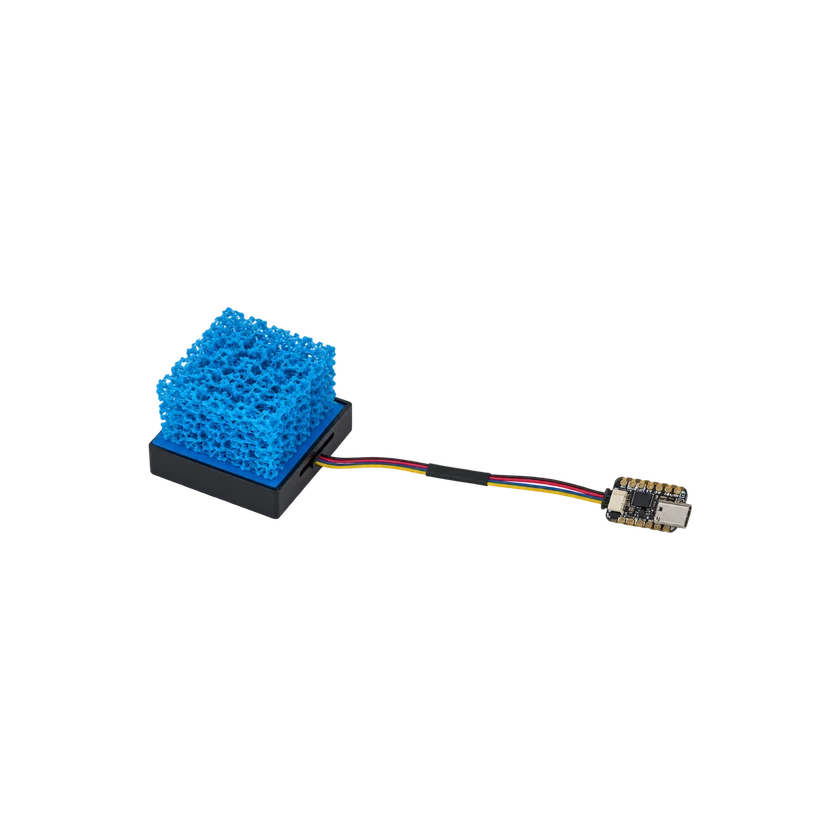
eFlesh is a customizable magnetic tactile sensor prototype developed at New York University. Its 3D-printed TPU lattice holds permanent magnets that move under load. A magnetometer board reads the field changes for contact localization and learned force estimation. The team shares design, print and readout files for research builds.
Technical specifications
Sensing capabilities and principle
Direct sensing
Three-axis magnetic flux density
Sensing method
Embedded permanent magnets move as the lattice deforms. A magnetometer PCB underneath reads the field change.
Sensing principle
Magnetic tactile sensing
Structure and dimensions
Mounting position
Gripper fingers
Physical form
Customizable sensor module
Output and communication
Connector
Reference board to QT Py: Qwiic (I²C)
Connector
QT Py to host: USB-C, virtual serial
Data output
Five sets of XYZ magnetic readings
Software, export and openness
Hardware openness
Public design tool, printable STL examples, readout code and upstream PCB files
Related entities and public cases
Publicly documented uses
UFactory xArm 7 research end effectors and gripper fingers
Publicly documented uses
Hello Robot Stretch gripper in slip-detection experiments
Publicly documented uses
Project demonstrations: Franka Arm, Allegro Hand, Unitree A1 and UMI Gripper
Publicly documented uses
RUKA illustration in the fingertip visualizer
Other technical parameters
Record type
Research prototype with public fabrication files
Other technical parameter
N52 neodymium magnets
Other technical parameter
Reference readout: five MLX90393 three-axis magnetometers
Other technical parameter
Example firmware I²C clock: 400 kHz
Other technical parameter
Stretch gripper slip classifier: 95% accuracy on 20 unseen objects
Other technical parameter
xArm 7 policy experiment: 100 Hz raw magnetometer data, synchronized and resampled at 10 Hz
overall sensor dimensions
Reference cuboid: 40 × 40 × 24 mm
standard cuboidal instance
Reference cuboid magnets: 9.525 mm diameter, 3.175 mm thick
indentation grid
Contact localization test grid: 30 × 30 mm
hemispherical indenter
Localization test: 6 mm diameter hemispherical probe, 1 mm grid spacing
indentation depth
Localization test indentation depth: 0.2–4.2 mm
RMSE x,y
Planar contact localization RMSE: 0.5 mm on the held-out pass
RMSE depth
Contact depth prediction RMSE: 0.16 mm on the held-out pass
compressive forces
Normal force applied in the flat-plate test: 0–30 N
normal force prediction RMSE
Normal force prediction RMSE in the flat-plate test: 0.27 N
training and validation
Localization model: first four grid passes for training, fifth for validation
Physical Specifications
Materials
3D-printed TPU 95A lattice
Battery and Runtime
Power Supply
QT Py SAMD21 reference controller: 5 V USB supply and 3.3 V Qwiic rail
Commercial Status
Status
Prototype
Price
Unknown
Release Date
Jun 18, 2025
Related Entities
No related products recorded yet.
Video
Timeline
- Robot releaseeFlesh
Submit a source or correction