Software integration · Simulation test · Real-robot experiment

Community portEvaluated onRobot test results
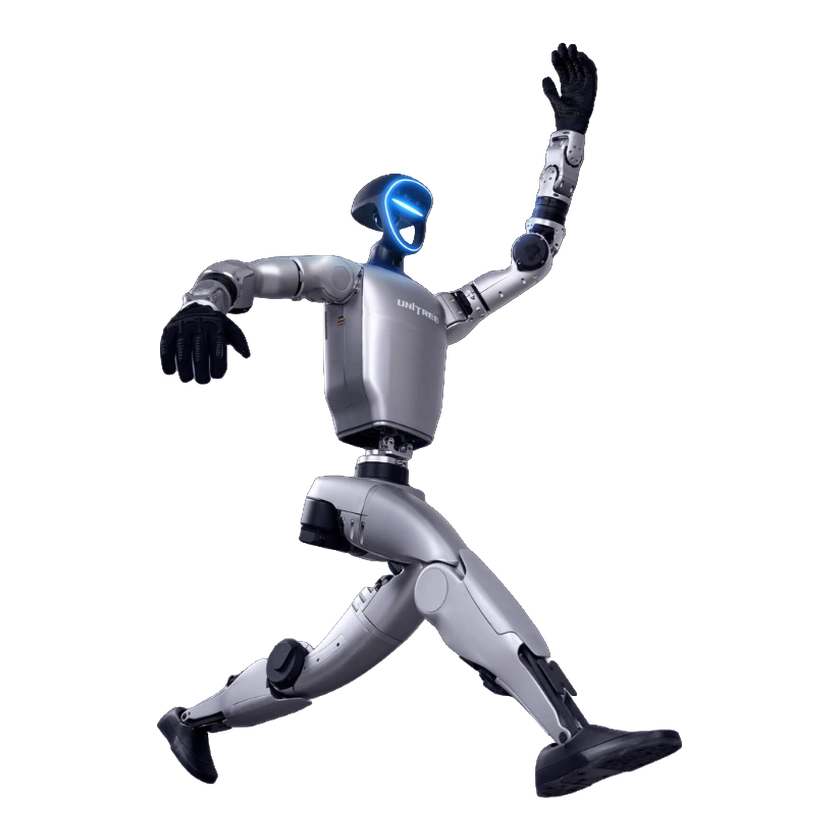
Official Unitree G1 training guidance configures the Pi0.5 base policy on a G1 dataset.
Table II reports PGX end-to-end success (C0/C1) of 90%/60% for box transport, 75%/90% for mug placement and 60%/55% for coffee fetching.
The Oxford team fine-tuned the π₀.₅ stage policy on 44 real demonstrations (176 segments) at 30 Hz. Figure 7 reports grasp, place, re-grasp and delivery rates among runs that reach each stage.
Scope: G1 research/training configuration; this is not a factory preinstallation or direct safety-validation claim.
Conditions: Requires the documented Unitree LeRobot environment and G1 dataset/configuration.
Integration solution
Train Pi05 Policy
--dataset.repo_id=unitreerobotics/G1_Dex3_ToastedBread_Dataset
--policy.type=pi05
--policy.pretrained_path=lerobot/pi05_base
Verified on: 2026-10-23
Scope: Simulation, with stage-trained manipulation skills. The coffee task requires triggering the machine and releasing the mug at delivery.
Conditions: Isaac Lab Arena with Unitree G1, Dex-3 hands and HOMIE whole-body control at 50 Hz. At least 20 episodes per cell. C0 uses the nominal start, while C1 varies each translation axis by ±0.30 m and yaw by ±30°. Time limits for box, mug and coffee are 40, 60 and 110 seconds.
Simulation / software configuration
We use π₀.₅ and GR00T N1.6 as skill backbones, fine-tuned on the same demonstrations.
Verified on: 2026-11-21
Scope: Unitree G1 with the left Dex-3 hand, Vicon and head/wrist cameras. The real task omits button pressing. GR00T-WBC handles locomotion.
Conditions: The real policy was trained separately from the 50 Hz simulation policy. The comparison in Fig. 7 uses the nominal (C0) simulation condition.
Physical verification
Real Unitree G1 coffee task. PGX with the π₀.₅ stage model, shown at 4× speed.
Verified on: 2026-11-21