
 HEBI Robotics
H25-140
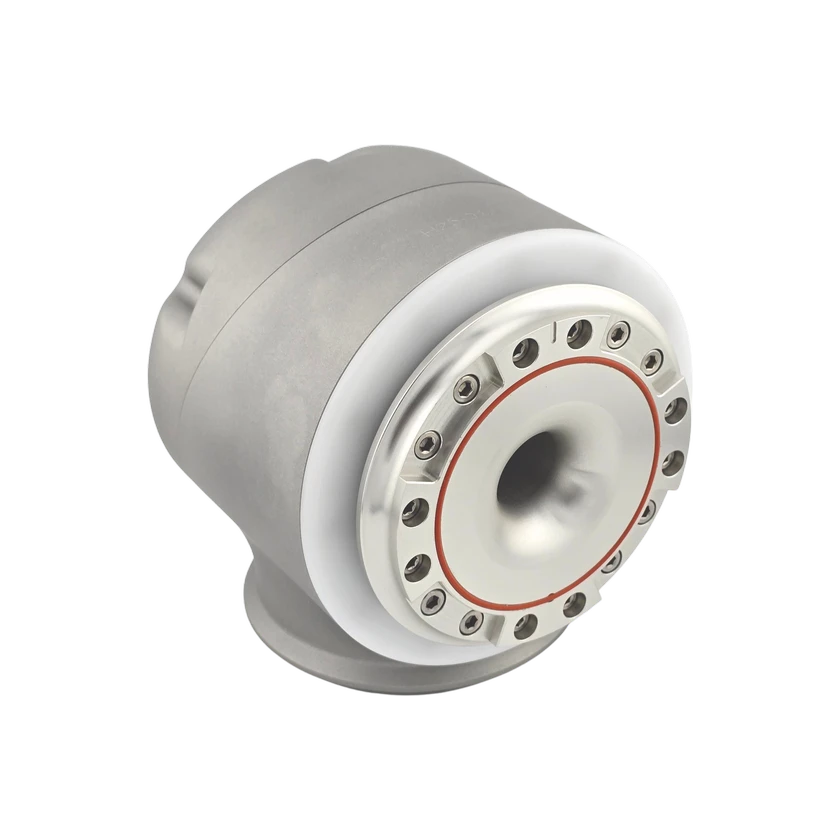
HEBI H25-140 integriert einen bürstenlosen Motor, ein Harmonic-Getriebe, Encoder und Steuerelektronik. Es liefert 140 N·m Dauerdrehmoment und 280 N·m Spitzendrehmoment bei maximal 30 rpm und nutzt 24–48 V DC sowie Glasfaser-Ethernet. Eine bei Stromausfall sperrende Bremse ist optional.
Technische Daten
Modelldaten · Konfigurationsbezug ungeprüft
- Sensortechnologie
- Encoder
- Sensortechnologie
- 3-Achsen-Beschleunigungsmesser und Gyroskop
- Entwicklungszugang
- Bedingt unterstützt
- Aktuatortechnologie
- Bürstenloser Motor mit Harmonic-Getriebe
- Schutzart (IP)
- Für IP65 ausgelegt
- Maximales Gelenkausgangsdrehmoment
- 280 N·m
- Höhe
- 11.4 cm
- Länge
- 12.6 cm
- Gewicht
- 2.9 kg
- Breite
- 11.5 cm
- Aktuatormodell
- H-Series-H25-140-Aktuator
- Gelenkencoder
- Encoder
- Maximale Drehzahl
- 30 rpm
- Betriebsspannung
- 24–48 V
- Getriebetyp
- Harmonic-Getriebe
- Kalibrierung
- Beim Start keine Kalibrierung oder Referenzfahrt erforderlich
- Zertifizierungen
- MIL-STD-461G RE102, RS103 (EMI/ESD)
- Zertifizierungen
- MIL-STD-810G 514.6, 516.6 (Stoß/Vibration)
- Zertifizierungen
- EMC-2014/30/EU
- Mensch-Roboter-Sicherheit
- Optional sperrende Bremse bei Stromausfall; M-Stop-Eingang 5–48 V DC
- Betriebstemperatur
- -10–50 °C
- Kommunikation
- 2× 100 Mbps Glasfaser-Ethernet
Quelle · 1
2026-09-24 · 2026-11-06
Sensortechnologie · encoder
Sensortechnologie · imu
Entwicklungszugang · H25-140 appears in the series configuration table; series datasheet explicitly documents C/C++ and Python APIs.
Aktuatortechnologie · harmonic_gear_reduction
Schutzart (IP) · Designed for IP65
Maximales Gelenkausgangsdrehmoment · 280 N·m
Höhe · 11.4 cm
Länge · 12.6 cm
Gewicht · 2.9 kg
Breite · 11.5 cm
Aktuatormodell · H-Series H25-140 actuator
Gelenkencoder · Encoders
Maximale Drehzahl · 30 rpm
Betriebsspannung · 24V - 48V DC
Getriebetyp · Harmonic-type reducer
Kalibrierung · No calibration or homing required at boot
Zertifizierungen · mil_std_461g_re102_rs103
Zertifizierungen · mil_std_810g_514_6_516_6
Zertifizierungen · emc_2014_30_eu
Mensch-Roboter-Sicherheit · Optional brake locks on power-off; M-Stop line input supports 5–48 V DC
Betriebstemperatur · -10°C to 50°C Ambient
Kommunikation · 2× 100 Mbps fiber-optic Ethernet (plastic optical fiber, OptoLock)
Modelle der Familie vergleichen
2–4 Konfigurationen auswählen
Ausgewählte Konfigurationen vergleichenEntwicklungsunterstützung
H25-140Aktuelles Modell
Bedingter ZugangH25-140 is explicitly listed in the official series datasheet with C/C++ and Python API support. Use compatible module firmware, matching API distribution, Ethernet discovery, exact family/name, calibrated actuator limits and model-specific gains. The reviewed native profile uses strategy 5 (FOC). H-Series motor torque feedback is current-based; this is not independent output strain-gauge torque measurement.
H25-90
Bedingter ZugangH25-90 is explicitly listed in the official series datasheet with C/C++ and Python API support. Use compatible module firmware, matching API distribution, Ethernet discovery, exact family/name, calibrated actuator limits and model-specific gains. The reviewed native profile uses strategy 5 (FOC). H-Series motor torque feedback is current-based; this is not independent output strain-gauge torque measurement.
H25-45
Bedingter ZugangH25-45 is explicitly listed in the official series datasheet with C/C++ and Python API support. Use compatible module firmware, matching API distribution, Ethernet discovery, exact family/name, calibrated actuator limits and model-specific gains. The reviewed native profile uses strategy 5 (FOC). H-Series motor torque feedback is current-based; this is not independent output strain-gauge torque measurement.
H25-140 is explicitly listed in the official series datasheet with C/C++ and Python API support. Use compatible module firmware, matching API distribution, Ethernet discovery, exact family/name, calibrated actuator limits and model-specific gains. The reviewed native profile uses strategy 5 (FOC). H-Series motor torque feedback is current-based; this is not independent output strain-gauge torque measurement.
Entwicklungsfunktionen
Each rotary module accepts joint-level position, velocity and effort commands through the discovered Group; radians, rad/s and N m apply in this strategy. This standalone actuator is not a complete arm or Cartesian controller.
Real Group command/feedback logging uses start_log/stop_log or C++ startLog/stopLog and .hebilog at the configured feedback frequency. Check log creation and directory permissions; Python log rollover may need a background thread. This is raw module telemetry, not an annotated multimodal demonstration dataset.
Pinned Python examples use hebi-py >=2.2.0, Python3 and GroupCommand.position/velocity/effort. Match the installed API/firmware and exact module identity; Python2 is excluded.
Pinned examples use native C++ GroupCommand and fetch hebi-cpp 3.15.0 with a fixed distribution checksum. Dependencies and matching firmware are required; no build or hardware execution is claimed.
GroupCommand.setPosition/position commands a rotary joint angle in radians with the matching position controller/gains enabled. It is an instantaneous setpoint; build and refresh trajectories separately.
The dedicated velocity example sets GroupCommand velocity in rad/s without a position target. Clear prior position commands with NaN and configure the velocity controller for the selected strategy; this is not merely a speed limit.
The combined position/velocity/effort example adds acceleration*inertia effort while tracking position and velocity. Strategy 5 (FOC) accepts additional user effort in N m; tune model-specific gains/inertia. It is not proof of whole-arm gravity compensation accuracy.
The dedicated effort example sends N m torque without position/velocity targets. Clear both previous targets using NaN and select strategy 5 (FOC). DIRECT_PWM normalized duty and direct FOC current/voltage are different modes. H-Series motor torque feedback is current-based; this is not independent output strain-gauge torque measurement.
Dokumentierte Einschränkungen
- H25-140 is explicitly listed in the official series datasheet with C/C++ and Python API support. Use compatible module firmware, matching API distribution, Ethernet discovery, exact family/name, calibrated actuator limits and model-specific gains. The reviewed native profile uses strategy 5 (FOC). H-Series motor torque feedback is current-based; this is not independent output strain-gauge torque measurement. Position/velocity targets are rad/rad/s and rotary effort is N m only in the selected control strategy. Clear stale targets explicitly with NaN; an empty command may retain setpoints, and zero effort actively requests zero torque rather than disabling control. Refresh commands within configured command lifetime (publisher default 250ms); do not treat this as a motion-performance guarantee. Persist required strategy/gain settings deliberately across reboot. H default strategy5 differs from X/R strategy4. Examples use one test module and hardcoded names; adapt identities, not firmware modes blindly. Example-code licensing excludes binary APIs/dependencies/firmware/hardware. No exact 4DoF arm-kit integration is inferred.
Quellen · 9
- Offizielldocs.hebi.us ↗Geprüft: 2026-11-06
- Offiziellraw.githubusercontent.com ↗Geprüft: 2026-11-06
- Offizielldocs.hebi.us ↗Geprüft: 2026-11-06
- Offiziellraw.githubusercontent.com ↗Geprüft: 2026-11-06
- Offiziellraw.githubusercontent.com ↗Geprüft: 2026-11-06
- Offiziellraw.githubusercontent.com ↗Geprüft: 2026-11-06
- Offiziellraw.githubusercontent.com ↗Geprüft: 2026-11-06
- Offiziellraw.githubusercontent.com ↗Geprüft: 2026-11-06
- Offizielldocs.hebi.us ↗Geprüft: 2026-11-06
Open Source und Bauunterlagen
Software
Teilweise veröffentlichtBeispiele oder Hilfswerkzeuge sind verfügbar; das Kernsystem ist damit nicht als offen belegt.
Hardwaredesign
Teilweise Hardware-DokumentationDie offizielle H-Serien-Dokumentation behandelt H25-45, H25-90 und H25-140 mit Maßzeichnungen, Klemmringen, Adaptern und Armlink-CAD sowie Strom-, Glasfaser-Ethernet- und M-Stop-Verdrahtung. Teilweise Integrationsunterlagen; vollständige Fertigungsdateien und Hardwarelizenz sind nicht verifiziert.
Erläuterung ansehenBauunterlagen
Nicht verifiziertFür diesen Bereich liegen noch keine ausreichenden verifizierten Belege vor.
| Typ | Ressource | Lizenz | Gültige Version | Öffnen |
|---|---|---|---|---|
| Code | HEBI native C++ examples · pinned Apache-2.0 primary code GitHub · HebiRobotics/hebi-cpp-examples The reviewed Apache-2.0 grant covers the primary example-project code at this commit. Downloaded C++ API wrapper/C binary distribution, dependencies, Python examples, firmware, actuator hardware and complete robot kits have separate licensing/access scope. | Apache-2.0 | hebi_h25_140_native_group_command | Öffnen GitHub |
| Hardware | HEBI H25: CAD-, Montage- und Verdrahtungsunterlagen docs.hebi.us Die offizielle H-Serien-Dokumentation behandelt H25-45, H25-90 und H25-140 mit Maßzeichnungen, Klemmringen, Adaptern und Armlink-CAD sowie Strom-, Glasfaser-Ethernet- und M-Stop-Verdrahtung. Teilweise Integrationsunterlagen; vollständige Fertigungsdateien und Hardwarelizenz sind nicht verifiziert. | — | H25-140 | Öffnen Dokumentation |
| Werkzeug | H25-140: Strategy-5-Verstärkungskonfiguration docs.hebi.us Offizielle XML-Ausgangsverstärkungen für H25-140. Die H-Serie verwendet Strategy 5; gemäß Herstellerhinweisen an Mechanik und Anwendung anpassen. Konfigurationsdatei, keine Aktuator-Firmwarequellen oder Roboter-Fertigungsunterlagen. Lizenzrechte sind nicht verifiziert. | — | H25-140 | Öffnen Dokumentation |
Kommerzieller Status
Verwandte Einträge
Noch keine verwandten Produkte erfasst.