
 HEBI Robotics
H25-140
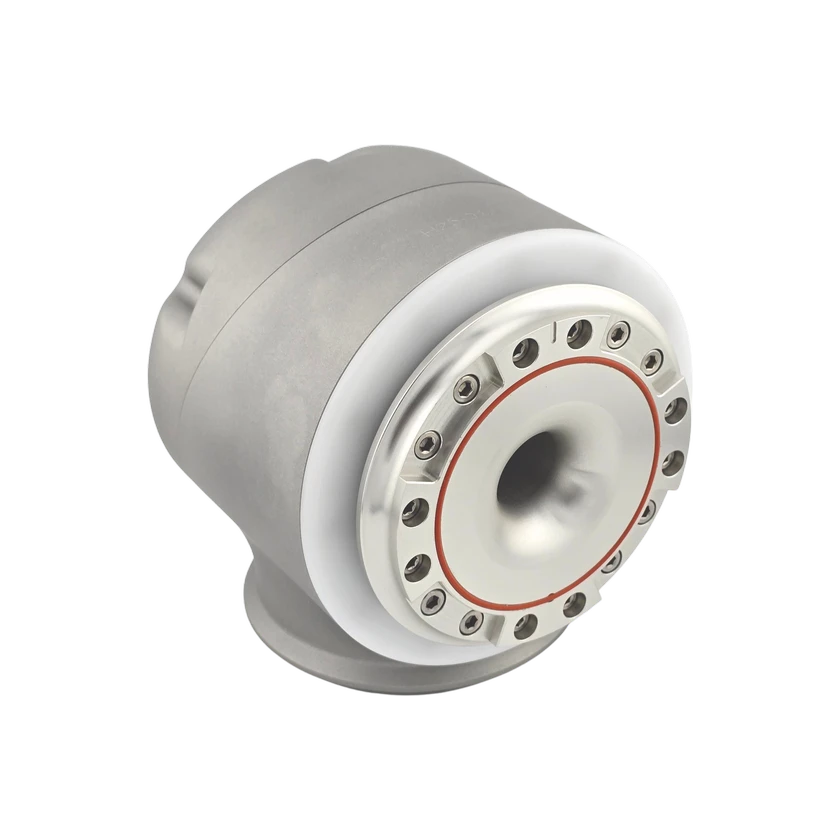
HEBI H25-140 integrates a brushless motor, harmonic reducer, encoders and control electronics. It delivers 140 N·m continuous and 280 N·m peak torque, with a maximum speed of 30 rpm, 24–48 V DC supply and fiber-optic Ethernet. A power-off locking brake is optional.
Technical specifications
Model-level records · configuration applicability unverified
- Sensing technology
- Encoder
- Sensing technology
- 3-axis accelerometer and gyroscope
- Development access
- Conditional support
- Actuator technology
- Brushless motor with harmonic gear reduction
- Ingress Protection (IP)
- Designed for IP65
- Peak Joint Output Torque
- 280 N·m
- Height
- 11.4 cm
- Length
- 12.6 cm
- Weight
- 2.9 kg
- Width
- 11.5 cm
- Actuator Model
- H-Series H25-140 actuator
- Joint Encoder
- Encoders
- Max RPM
- 30 rpm
- Operating voltage
- 24–48 V
- Reducer Type
- Harmonic-type reducer
- Calibration
- No calibration or homing required at boot
- Certifications
- MIL-STD-461G RE102, RS103 (EMI/ESD)
- Certifications
- MIL-STD-810G 514.6, 516.6 (shock/vibration)
- Certifications
- EMC-2014/30/EU
- Human-Robot Safety
- Optional power-off locking brake; M-Stop input 5–48 V DC
- Operating temperature
- -10–50 °C
- Communication
- 2× 100 Mbps fiber-optic Ethernet
Source · 1
2026-09-24 · 2026-11-06
Sensing technology · encoder
Sensing technology · imu
Development access · H25-140 appears in the series configuration table; series datasheet explicitly documents C/C++ and Python APIs.
Actuator technology · harmonic_gear_reduction
Ingress Protection (IP) · Designed for IP65
Peak Joint Output Torque · 280 N·m
Height · 11.4 cm
Length · 12.6 cm
Weight · 2.9 kg
Width · 11.5 cm
Actuator Model · H-Series H25-140 actuator
Joint Encoder · Encoders
Max RPM · 30 rpm
Operating voltage · 24V - 48V DC
Reducer Type · Harmonic-type reducer
Calibration · No calibration or homing required at boot
Certifications · mil_std_461g_re102_rs103
Certifications · mil_std_810g_514_6_516_6
Certifications · emc_2014_30_eu
Human-Robot Safety · Optional brake locks on power-off; M-Stop line input supports 5–48 V DC
Operating temperature · -10°C to 50°C Ambient
Communication · 2× 100 Mbps fiber-optic Ethernet (plastic optical fiber, OptoLock)
Compare family models
Choose 2–4 configurations
Compare selected configurationsDevelopment support
H25-140Current model
Conditional accessH25-140 is explicitly listed in the official series datasheet with C/C++ and Python API support. Use compatible module firmware, matching API distribution, Ethernet discovery, exact family/name, calibrated actuator limits and model-specific gains. The reviewed native profile uses strategy 5 (FOC). H-Series motor torque feedback is current-based; this is not independent output strain-gauge torque measurement.
H25-90
Conditional accessH25-90 is explicitly listed in the official series datasheet with C/C++ and Python API support. Use compatible module firmware, matching API distribution, Ethernet discovery, exact family/name, calibrated actuator limits and model-specific gains. The reviewed native profile uses strategy 5 (FOC). H-Series motor torque feedback is current-based; this is not independent output strain-gauge torque measurement.
H25-45
Conditional accessH25-45 is explicitly listed in the official series datasheet with C/C++ and Python API support. Use compatible module firmware, matching API distribution, Ethernet discovery, exact family/name, calibrated actuator limits and model-specific gains. The reviewed native profile uses strategy 5 (FOC). H-Series motor torque feedback is current-based; this is not independent output strain-gauge torque measurement.
H25-140 is explicitly listed in the official series datasheet with C/C++ and Python API support. Use compatible module firmware, matching API distribution, Ethernet discovery, exact family/name, calibrated actuator limits and model-specific gains. The reviewed native profile uses strategy 5 (FOC). H-Series motor torque feedback is current-based; this is not independent output strain-gauge torque measurement.
Development capabilities
Each rotary module accepts joint-level position, velocity and effort commands through the discovered Group; radians, rad/s and N m apply in this strategy. This standalone actuator is not a complete arm or Cartesian controller.
Real Group command/feedback logging uses start_log/stop_log or C++ startLog/stopLog and .hebilog at the configured feedback frequency. Check log creation and directory permissions; Python log rollover may need a background thread. This is raw module telemetry, not an annotated multimodal demonstration dataset.
Pinned Python examples use hebi-py >=2.2.0, Python3 and GroupCommand.position/velocity/effort. Match the installed API/firmware and exact module identity; Python2 is excluded.
Pinned examples use native C++ GroupCommand and fetch hebi-cpp 3.15.0 with a fixed distribution checksum. Dependencies and matching firmware are required; no build or hardware execution is claimed.
GroupCommand.setPosition/position commands a rotary joint angle in radians with the matching position controller/gains enabled. It is an instantaneous setpoint; build and refresh trajectories separately.
The dedicated velocity example sets GroupCommand velocity in rad/s without a position target. Clear prior position commands with NaN and configure the velocity controller for the selected strategy; this is not merely a speed limit.
The combined position/velocity/effort example adds acceleration*inertia effort while tracking position and velocity. Strategy 5 (FOC) accepts additional user effort in N m; tune model-specific gains/inertia. It is not proof of whole-arm gravity compensation accuracy.
The dedicated effort example sends N m torque without position/velocity targets. Clear both previous targets using NaN and select strategy 5 (FOC). DIRECT_PWM normalized duty and direct FOC current/voltage are different modes. H-Series motor torque feedback is current-based; this is not independent output strain-gauge torque measurement.
Documented constraints
- H25-140 is explicitly listed in the official series datasheet with C/C++ and Python API support. Use compatible module firmware, matching API distribution, Ethernet discovery, exact family/name, calibrated actuator limits and model-specific gains. The reviewed native profile uses strategy 5 (FOC). H-Series motor torque feedback is current-based; this is not independent output strain-gauge torque measurement. Position/velocity targets are rad/rad/s and rotary effort is N m only in the selected control strategy. Clear stale targets explicitly with NaN; an empty command may retain setpoints, and zero effort actively requests zero torque rather than disabling control. Refresh commands within configured command lifetime (publisher default 250ms); do not treat this as a motion-performance guarantee. Persist required strategy/gain settings deliberately across reboot. H default strategy5 differs from X/R strategy4. Examples use one test module and hardcoded names; adapt identities, not firmware modes blindly. Example-code licensing excludes binary APIs/dependencies/firmware/hardware. No exact 4DoF arm-kit integration is inferred.
Sources · 9
- Officialdocs.hebi.us ↗Verified: 2026-11-06
- Officialraw.githubusercontent.com ↗Verified: 2026-11-06
- Officialdocs.hebi.us ↗Verified: 2026-11-06
- Officialraw.githubusercontent.com ↗Verified: 2026-11-06
- Officialraw.githubusercontent.com ↗Verified: 2026-11-06
- Officialraw.githubusercontent.com ↗Verified: 2026-11-06
- Officialraw.githubusercontent.com ↗Verified: 2026-11-06
- Officialraw.githubusercontent.com ↗Verified: 2026-11-06
- Officialdocs.hebi.us ↗Verified: 2026-11-06
Open source & build resources
Software
Partially availableExamples or supporting tools are available; this does not establish access to the core system.
Hardware design
Partial hardware documentationOfficial H-Series documentation covers H25-45, H25-90 and H25-140 and links dimensional drawings, collar clamps, adapters and arm-link CAD. It also explains power, fiber Ethernet and M-Stop wiring. These are partial integration materials; complete actuator manufacturing files and hardware licensing have not been verified.
View explanationBuild resources
Not verifiedThere is not enough verified evidence to establish this dimension.
| Type | Resource | License | Applicable version | Open |
|---|---|---|---|---|
| Code | HEBI native C++ examples · pinned Apache-2.0 primary code GitHub · HebiRobotics/hebi-cpp-examples The reviewed Apache-2.0 grant covers the primary example-project code at this commit. Downloaded C++ API wrapper/C binary distribution, dependencies, Python examples, firmware, actuator hardware and complete robot kits have separate licensing/access scope. | Apache-2.0 | hebi_h25_140_native_group_command | Open GitHub |
| Hardware | HEBI H25 CAD, mounting and wiring references docs.hebi.us Official H-Series documentation covers H25-45, H25-90 and H25-140 and links dimensional drawings, collar clamps, adapters and arm-link CAD. It also explains power, fiber Ethernet and M-Stop wiring. These are partial integration materials; complete actuator manufacturing files and hardware licensing have not been verified. | — | H25-140 | Open documentation |
| Tool | H25-140 Strategy 5 gain configuration docs.hebi.us Official downloadable XML starting gains for H25-140. H-Series supports Strategy 5; tune gains for the actual mechanism and application using the manufacturer's guidance. This is a configuration file, not actuator firmware source or a robot manufacturing package. License permissions have not been verified. | — | H25-140 | Open documentation |
Commercial Status
Related Entities
No related products recorded yet.