WorldWeave

Method / tool

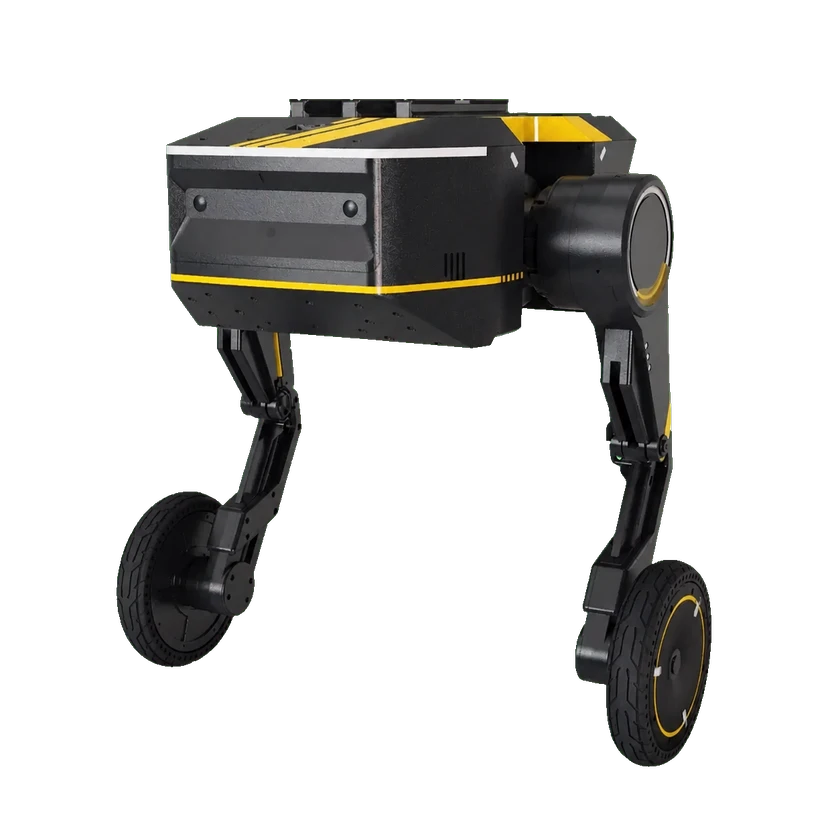
WorldWeave is a cross-task world model for vision-and-language navigation and embodied visual tracking. It learns shared predictive dynamics from consecutive observations and adapts them to each task. In closed-loop TITA robot tests, success rates were 66.7% for navigation and 66.0% for tracking.

View full model description

Papers & reports (1)

WorldWeave: Rethinking Embodied Navigation through Cross-Task World Modeling

Paper available

arXiv: 2611.28553DOI: 10.48550/arxiv.2611.28553
Authors & affiliations (6)

Author order: Original order

  1. Xuan Yao

    State Key Laboratory of Multimodal Artificial Intelligence Systems (MAIS), Institute of Automation, Chinese Academy of Sciences · School of Artificial Intelligence, University of Chinese Academy of Sciences · HiThink Research

  2. Jiahao Zhang

    State Key Laboratory of Multimodal Artificial Intelligence Systems (MAIS), Institute of Automation, Chinese Academy of Sciences · HiThink Research

  3. Rongjunchen Zhang

    HiThink Research

  4. Kaixuan Huang

    HiThink Research

  5. Junyu Gao

    State Key Laboratory of Multimodal Artificial Intelligence Systems (MAIS), Institute of Automation, Chinese Academy of Sciences · School of Artificial Intelligence, University of Chinese Academy of Sciences

  6. Changsheng Xu

    State Key Laboratory of Multimodal Artificial Intelligence Systems (MAIS), Institute of Automation, Chinese Academy of Sciences · School of Artificial Intelligence, University of Chinese Academy of Sciences · Peng Cheng Laboratory

First published
Not provided
Latest paper revision
v1 · 2026-11-21
Venue
Not provided

Covered model versions

Paper ↗PDF ↗

How to access and use

Training code for this version is unconfirmed. Public code resources do not establish access to the exact training implementation. View verification notes

Training / fine-tuning code

Checks before deployment

Available weights or code do not establish plug-and-play robot compatibility. Check the required configuration, data and interfaces in the source documentation.

Architecture and inputs / outputs

Model type
Navigation
Architecture
WAM
Backbone
Qwen3-VL-4B
Input
Language / RGB images

Scope and training

Functional purpose

world_prediction

Output

Actions / Future states

Prediction output

Next latent state

Robot form

Ground mobile robot

Task scope

Multiple tasks

Training

Pretraining / Supervised fine-tuning

Related robots

Evaluation results

No verified independent benchmark results are recorded for this version or the selected weights.

Full parameters and verification notes (model card)

The Qwen3-VL-4B backbone receives monocular observations and task instructions. The shared dynamics predict the next latent state and feed task-specific decision heads. The paper names R2R-CE, RxR-CE, VLN-PE and VLNVerse for navigation, and EVT-Bench, UnrealZoo and Gym-UnrealCV for tracking. Section 4.4 reports closed-loop tests on a TITA wheeled-legged robot in previously unseen indoor environments. The matched baselines scored 46.0% on navigation and 48.7% on tracking.

Submit a source or correction