MAWAM: A Multi-Agent World-Action Model for Coordinated Manipulation
Paper available
Authors & affiliations (13)
Author order: Original order
- First published
- 2026-11-20
- Latest paper revision
- v1
- Venue
- Not provided
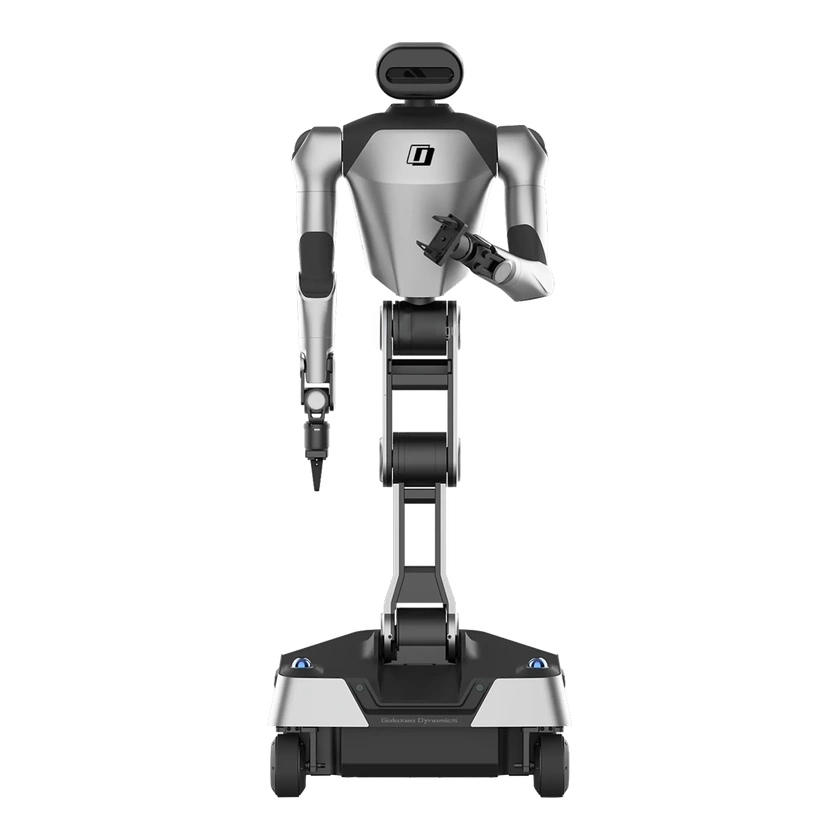
MAWAM adapts GR00T 2 for coordinated manipulation. It jointly predicts every robot’s future camera views and action chunks through cross-agent attention, while preserving separate control interfaces. The authors evaluated two Galaxea R1 Pro robots and teams of two to four simulated Panda arms.
View full model descriptionPaper available
Author order: Original order
Training code for this version is unconfirmed. Public code resources do not establish access to the exact training implementation. View verification notes
SourceVerified on · 2026-11-20
Available weights or code do not establish plug-and-play robot compatibility. Check the required configuration, data and interfaces in the source documentation.
ee_pose · continuous
16 DoF · horizon 24 · relative
Actions / Video
24-step action chunk per robot and eight future frames per private view, one frame every three control steps
Dual-arm platform / Robotic arm
Multiple tasks
Imitation learning / Supervised fine-tuning
Fine-tuned from: GR00T · GR00T 2 ↗
No verified independent benchmark results are recorded for this version or the selected weights.
Publisher evaluation · Reported; not independently reproduced
MAWAM real-robot evaluation · Three-task mean ↗Success rate: 67.8 %
Table 1, two Galaxea R1 Pro robots, six private cameras, 30 trials per task.
Publisher evaluation · Reported; not independently reproduced
RoboFactory · Eight-task mean (MAWAM protocol) ↗Success rate: 90.3 %
Table 2: two to four simulated Panda arms, 100 evaluation episodes per task.
Inputs include a language instruction, camera histories, robot states, embodiment metadata, roles, and view ownership. A shared simulation camera can supply read-only context. Each prediction covers 24 control steps and eight future frames per private view. Robots execute eight steps in sync and replan. The authors report 67.8% across three real tasks (30 trials each) and 90.3% across eight RoboFactory tasks (100 episodes each). Table 9 reports 2.76 billion trainable parameters, excluding frozen Cosmos-Reason1 and the video VAE.