


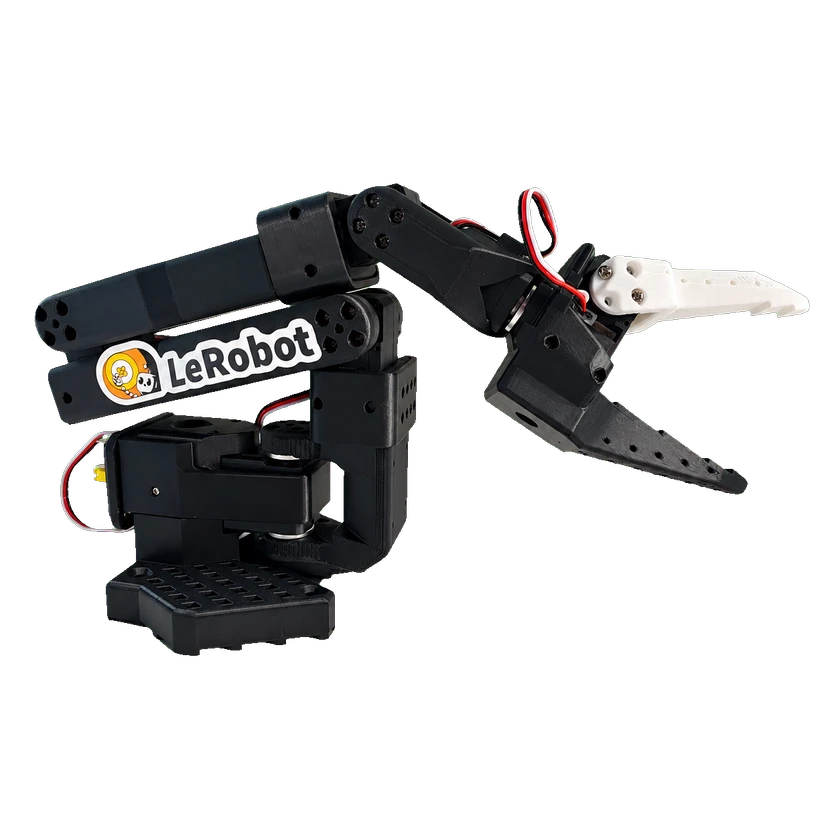
Robot Arms
SO-101
FastWAM base ↗Software integration
Official FastWAM documentation provides an SO-101 real-robot integration path.
Requires a compatible SO-101 follower configuration and a trained FastWAM real-robot checkpoint.
Version scope and roles for these associations await verification.
Choose a version to compare
A world action model from Tsinghua University’s IIIS and Galaxea AI. It learns video prediction and action generation together, while the base model decodes actions directly at inference. Original checkpoints were published on March 23, 2026. Optional IDM adds two selectable inference modes.
Robot models: 1 · Version relationships: 1
Experiments do not imply factory configuration. Evidence applies only to the named model version.
Robot Arms
Official FastWAM documentation provides an SO-101 real-robot integration path.
Requires a compatible SO-101 follower configuration and a trained FastWAM real-robot checkpoint.
LeRobot can now return predicted camera frames alongside FastWAM actions. The option is off by default. Enabling it leaves action predictions unchanged in the reported tests and adds one video denoising pass and one VAE decode per action chunk.
Previously reported
The LeRobot FastWAM policy returned actions without predicted camera frames through select_action.
This announcement
Set --policy.return_predicted_video=true to return predicted frames by camera alongside corresponding actions. Use --display_data=true in lerobot-rollout to view them. Frames are attached only when the frame index changes. Consecutive actions mapped to the same frame return the action alone after the first.
The fixed LeRobot main-branch commit also covers the Dock of Transformers (DoT) and Lite KV-Fusion path for the shallow Faster-WAM action expert (arXiv:2608.02365). Video is generated separately, bypassing the joint forward path that rejects shallow experts. The PR reports small-model tests only. Latency, GPU memory and real-robot behavior were not measured for this option. As of November 24, 2026, the latest stable release, v0.7.0, does not contain this change. The commit contains no new weights.
The WAMotor authors published a speculative inference implementation for Fast-WAM-Joint. It reuses denoising velocities without training a separate draft model and was evaluated on LIBERO, RoboTwin 2.0 and LIBERO-Plus.
Previously reported
The study uses this model’s standard flow-matching inference as its baseline.
This announcement
The authors used an RTX 5090 and measured inference latency per action chunk and mean task success. Each row compares standard inference with WAMotor. LIBERO (40 tasks × 50 trials) — 660.83 → 216.44 ms (3.05×), 98.35% → 98.00% RoboTwin 2.0 (50 tasks × 100 trials in each of clean and randomized settings) — 661.53 → 217.87 ms (3.04×), 90.70% → 90.80% LIBERO-Plus (10,030 instances × 3 trials across seven types of shift) — 665.66 → 212.54 ms (3.13×), 66.43% → 67.30%
The adapter extrapolates video and actions jointly. Acceptance is based on the action-velocity residual. The WAMotor implementation defaults to 10 denoising steps, BF16 and Shift-5. Speculation starts after one Euler update, uses a verification threshold of 0.01 calibrated to the median step size and caps the window at the denoising step count. Enable it with --speculative. The LIBERO-Plus launcher defaults to a 15% task sample, seed 42 and one trial per instance. The numbers above come from the full study protocol. The paper cites the Fast-WAM-Joint controlled variant. The adapter uses Shift-5 for both video and actions. The upstream Fast-WAM-Joint configuration uses action shift 1.0 and video shift 5.0. No independent evaluation weights or exact tested checkpoint hashes were verified. The repository provides a 2-camera LIBERO task config (also used for LIBERO-Plus) and a 3-camera RoboTwin task config. Their mode is joint_rollout.
The WAMotor authors published a speculative inference implementation for Fast-WAM. It reuses denoising velocities without training a separate draft model and was evaluated on LIBERO, RoboTwin 2.0 and LIBERO-Plus.
Previously reported
The study uses this model’s standard flow-matching inference as its baseline.
This announcement
The authors used an RTX 5090 and measured inference latency per action chunk and mean task success. Each row compares standard inference with WAMotor. LIBERO (40 tasks × 50 trials) — 387.54 → 92.57 ms (4.19×), 97.10% → 97.10% RoboTwin 2.0 (50 tasks × 100 trials in each of clean and randomized settings) — 398.07 → 98.95 ms (4.02×), 91.43% → 91.45% LIBERO-Plus (10,030 instances × 3 trials across seven types of shift) — 391.43 → 91.51 ms (4.28×), 50.17% → 51.16%
Fast-WAM keeps a fixed visual cache of the observed frame and applies speculation to action denoising. The WAMotor implementation defaults to 10 denoising steps, BF16 and Shift-5. Speculation starts after one Euler update, uses a verification threshold of 0.01 calibrated to the median step size and caps the window at the denoising step count. Enable it with --speculative. The LIBERO-Plus launcher defaults to a 15% task sample, seed 42 and one trial per instance. The numbers above come from the full study protocol. The published native checkpoint entry is yuanty/fastwam. The paper’s separate schedule comparison on Fast-WAM uses Uniform, Shift-5, Shift-0.2 and Cosine on LIBERO-Plus. The repository provides a 2-camera LIBERO task config (also used for LIBERO-Plus) and a 3-camera RoboTwin task config. Their mode is joint_rollout. The WAMotor paper gives no exact checkpoint hashes.
An Optional IDM LIBERO checkpoint is released; one trained artifact supports idm and first_frame selection without retraining.
Previously reported
Original Fast-WAM and paper IDM ablations are separate trained variants.
This announcement
An Optional IDM LIBERO checkpoint is released; one trained artifact supports idm and first_frame selection without retraining.
Ordinary: adds a research comparison variant, without independently established major capability or rights change. The current card reports IDM98.55% and first_frame97.75% under shift1.0,40tasks×50episodes; these are not original-base or LeRobot scores.
Author code history adds acceleration and an optional-IDM implementation; current README reports H20 470→210ms and RTX4090 190→110ms including text/VAE encoding.
Previously reported
Original code used the earlier inference path; no optional-IDM implementation was recorded in README history.
This announcement
Author code history adds acceleration and an optional-IDM implementation; current README reports H20 470→210ms and RTX4090 190→110ms including text/VAE encoding.
Ordinary: code optimization is useful, but incomplete timing protocol does not establish a universal deployment threshold or new control capability. Current README timings are not asserted to have been published on August13. Optional IDM weights arrive separately August17; PR43 remains open.
LeRobot publishes fastwam_base as a mirror of maximellerbach/fastwam_base.
Previously reported
Original author-native packages were already public; this named LeRobot repository did not yet have a commit.
This announcement
LeRobot publishes fastwam_base as a mirror of maximellerbach/fastwam_base.
Ordinary: a mirror/integration event. June18 is this named package’s publication date, not the first Fast-WAM method, author-native weights or upstream contributor release. The preserved July6 revision and Apache-2.0 card remain distinct from native packages.
The author repository uploads original LIBERO and RoboTwin PyTorch weights and matching dataset statistics.
Previously reported
The method paper was already public; native Hub history had not yet recorded model files.
This announcement
The author repository uploads original LIBERO and RoboTwin PyTorch weights and matching dataset statistics.
Featured: the first documented author-native LIBERO/RoboTwin weights add a runnable native research path after the method disclosure. This does not assert the first release of every implementation. The current native card omits a weight license; MIT code terms do not settle weight rights.
Fast-WAM proposes video/action co-training while omitting future-video prediction during action inference.
Previously reported
Imagine-then-execute world-action models generate future video before or alongside actions.
This announcement
Fast-WAM proposes video/action co-training while omitting future-video prediction during action inference.
Featured: a new control architecture materially changes the inference-compute choice. March17 is first paper disclosure, not a verified weight launch. Later v2 measurements, August Optional IDM and hardware timings retain their own dates/scopes.
Humanoid Benchmark C6 Bathroom Door Fetch / b512-cont4k · November 23, 2026
FastWAM · Humanoid Benchmark C6 Bathroom Door Fetch (b512-cont4k)Paper / report unconfirmedCode and weights
Default checkpoint · C6 Bathroom Door Fetch · b512-cont4k · step-012000
Humanoid Benchmark A14 cropped-v3-b512-cont2k · November 23, 2026
FastWAM · Humanoid Benchmark A14 Bulb Installation (cropped-v3-b512-cont2k)Paper / report unconfirmedCode and weights
Default checkpoint · A14 · cropped-v3-b512-cont2k · step-006000
Humanoid Benchmark B7 green / b512-cont2k · November 22, 2026
FastWAM · Humanoid Benchmark B7 Green Garment to Hamper (b512-cont2k)Paper / report unconfirmedCode and weights
Default checkpoint · Humanoid Benchmark B7 Green Garment to Hamper (b512-cont2k) · step-006000
Humanoid Benchmark A17 Unscrew Bottle / b512-cont2k · November 22, 2026
FastWAM · Humanoid Benchmark A17 Bottle Cap Unscrewing (b512-cont2k)Paper / report unconfirmedCode and weights
Default checkpoint · A17 Bottle Cap Unscrewing · b512-cont2k · step-006000
Humanoid Benchmark A3 Fridge Open v4 / b512-cont2k · November 22, 2026
FastWAM · Humanoid Benchmark A3 Fridge Open v4 (b512-cont2k)Paper / report unconfirmedCode and weights
Default checkpoint · A3 Fridge Open v4 · b512-cont2k · step-006000
Humanoid Benchmark B7 Black Garment to Hamper / b512-cont2k · November 22, 2026
FastWAM · Humanoid Benchmark B7 Black Garment to Hamper (b512-cont2k)Paper / report unconfirmedCode and weights
Default checkpoint · B7 Black Garment to Hamper · b512-cont2k · step-006000
Humanoid Benchmark A14 cropped-v3 / b512 · November 21, 2026
FastWAM · Humanoid Benchmark A14 (Cropped v3 b512)Paper / report unconfirmedCode and weights
Default checkpoint · A14 cropped-v3-b512 · step-004000
B5 b512-cont2k · November 21, 2026
FastWAM · Humanoid Benchmark B5 Chair Push (b512-cont2k)Paper / report unconfirmedCode and weights
Default checkpoint · B5 Chair Push · Step 6,000
Humanoid Benchmark B7 green / b512 · November 20, 2026
FastWAM · Humanoid Benchmark B7 Green Garment to Hamper (b512)Paper / report unconfirmedCode and weights
Default checkpoint · B7 Green Garment · Step 4,000
Humanoid Benchmark B6 v6 / b512 · November 19, 2026
FastWAM · Humanoid Benchmark B6 v6Paper / report unconfirmedCode and weights
Default checkpoint · FastWAM · Humanoid Benchmark B6 v6 · 4000
Humanoid Benchmark B1 / b512 · November 19, 2026
FastWAM · Humanoid Benchmark B1 Riceball Microwave (b512)Paper / report unconfirmedCode and weights
Default checkpoint · B1 b512 · step 4,000
Humanoid Benchmark A14v2 / b512 · November 19, 2026
FastWAM · Humanoid Benchmark A14v2 Bulb InstallationPaper / report unconfirmedCode and weights
Default checkpoint · FastWAM · Humanoid Benchmark A14v2 Bulb Installation · 4000
Humanoid Benchmark C6 Bathroom Door Fetch / b512 · November 18, 2026
FastWAM · Humanoid Benchmark C6 Bathroom Door Fetch (b512)Paper / report unconfirmedCode and weights
Default checkpoint · C6 Bathroom Door Fetch · b512 · step-008000
10.4.13
FastWAM V10.4.13 junjie008 mix2000Paper / report unconfirmedWeights only
Default checkpoint · FastWAM V10.4.13 junjie008 mix2000 step28000
FastWAM base · June 18, 2026
FastWAM basePaper availableCode and weights
Related robots · 1
Default checkpoint · lerobot/fastwam_base
Fast-WAM-Joint
Fast-WAM-JointPaper availableFastWAM native · March 23, 2026
FastWAM nativePaper availableCode and weights
FastWAM Optional IDM · August 17, 2026
FastWAM Optional IDMPaper availableCode and weights
Paper available
Author order: Original order
Original Fast-WAM method and reported native research experiments. Published LIBERO97.6/RoboTwin91.8 and RTX5090DV2 model latency190ms are distinct from later Optional IDM card and H20/RTX4090 optimized code timings. Not verified per downloadable artifact.
Foundational Fast-WAM method reference only. Later Optional IDM single-checkpoint two-mode release and LIBERO98.55/97.75 come from author artifact/card, not the paper’s separately trained Fast-WAM-IDM ablation.
Fast-WAM-Joint controlled joint video-action denoising variant, as defined in §3.3 and evaluated in §4.3. No exact downloadable checkpoint confirmed.
Title not provided
Humanoid Benchmark · Code repository
Publication date unknown · Accessed: 2026-11-23
Title not provided
Humanoid Benchmark · Code repository
Publication date unknown · Accessed: 2026-11-23
Title not provided
Humanoid Benchmark · Code repository
Publication date unknown · Accessed: 2026-11-23
Title not provided
Humanoid Benchmark · Code repository
Published: 2026-11-22 · Accessed: 2026-11-23
Title not provided
Humanoid Benchmark · Code repository
Publication date unknown · Accessed: 2026-11-23
Title not provided
Humanoid Benchmark · Code repository
Publication date unknown · Accessed: 2026-11-23
Title not provided
Humanoid Benchmark · Code repository
Publication date unknown · Accessed: 2026-11-23
Title not provided
Humanoid Benchmark · Code repository
Publication date unknown · Accessed: 2026-11-23
Title not provided
Humanoid Benchmark · Code repository
Publication date unknown · Accessed: 2026-11-23
Title not provided
Humanoid Benchmark · Code repository
Publication date unknown · Accessed: 2026-11-23
Title not provided
Humanoid Benchmark · Code repository
Publication date unknown · Accessed: 2026-11-23
Title not provided
Humanoid Benchmark · Code repository
Publication date unknown · Accessed: 2026-11-23
Title not provided
Humanoid Benchmark · Code repository
Publication date unknown · Accessed: 2026-11-23
Title not provided
Humanoid Benchmark · Code repository
Published: 2026-11-22 · Accessed: 2026-11-23
Title not provided
Humanoid Benchmark · Code repository
Publication date unknown · Accessed: 2026-11-23
Title not provided
Humanoid Benchmark · Code repository
Publication date unknown · Accessed: 2026-11-23
Title not provided
Humanoid Benchmark · Code repository
Publication date unknown · Accessed: 2026-11-23
Humanoid Benchmark · Code repository
Published: 2026-11-23 · Accessed: 2026-11-23
Humanoid Benchmark · Code repository
Publication date unknown · Accessed: 2026-11-23
Humanoid Benchmark · Code repository
Publication date unknown · Accessed: 2026-11-23
FastWAM Authors · Code repository
Publication date unknown · Accessed: 2026-11-19
Humanoid Benchmark · Code repository
Publication date unknown · Accessed: 2026-11-23
Humanoid Benchmark · Code repository
Publication date unknown · Accessed: 2026-11-22
Humanoid Benchmark · Source
Publication date unknown · Accessed: 2026-11-20
Humanoid Benchmark · Code repository
Published: 2026-11-22 · Accessed: 2026-11-22
Humanoid Benchmark · Code repository
Publication date unknown · Accessed: 2026-11-22
Humanoid Benchmark · Code repository
Publication date unknown · Accessed: 2026-11-22
Humanoid Benchmark · Code repository
Publication date unknown · Accessed: 2026-11-22
Humanoid Benchmark · Code repository
Publication date unknown · Accessed: 2026-11-22
Title not provided
Humanoid Benchmark · Code repository
Published: 2026-11-22 · Accessed: 2026-11-23
Title not provided
Humanoid Benchmark · Code repository
Published: 2026-11-16 · Accessed: 2026-11-23
Title not provided
Humanoid Benchmark · Code repository
Publication date unknown · Accessed: 2026-11-23
Title not provided
Humanoid Benchmark · Code repository
Publication date unknown · Accessed: 2026-11-23
Title not provided
Humanoid Benchmark · Code repository
Publication date unknown · Accessed: 2026-11-23
Title not provided
Humanoid Benchmark · Code repository
Publication date unknown · Accessed: 2026-11-23
Humanoid Benchmark · Code repository
Published: 2026-11-22 · Accessed: 2026-11-22
Humanoid Benchmark · Code repository
Publication date unknown · Accessed: 2026-11-22
Humanoid Benchmark · Code repository
Publication date unknown · Accessed: 2026-11-22
Humanoid Benchmark · Code repository
Publication date unknown · Accessed: 2026-11-22
Wan-AI · Model card
Publication date unknown · Accessed: 2026-11-20
Publisher not provided · Model card
Publication date unknown · Accessed: 2026-11-20
Humanoid Benchmark · Code repository
Publication date unknown · Accessed: 2026-11-22
Humanoid Benchmark · Code repository
Publication date unknown · Accessed: 2026-11-22
FastWAM Authors · Code repository
Publication date unknown · Accessed: 2026-11-20
Title not provided
Humanoid Benchmark · Code repository
Published: 2026-11-22 · Accessed: 2026-11-22
Title not provided
Humanoid Benchmark · Code repository
Published: 2026-11-17 · Accessed: 2026-11-22
Title not provided
Humanoid Benchmark · Code repository
Publication date unknown · Accessed: 2026-11-22
Title not provided
Humanoid Benchmark · Code repository
Publication date unknown · Accessed: 2026-11-22
Title not provided
Humanoid Benchmark · Code repository
Publication date unknown · Accessed: 2026-11-22
Humanoid Benchmark · Code repository
Publication date unknown · Accessed: 2026-11-21
Humanoid Benchmark · Code repository
Publication date unknown · Accessed: 2026-11-21
Humanoid Benchmark · Model card
Publication date unknown · Accessed: 2026-11-21
Humanoid Benchmark · Code repository
Publication date unknown · Accessed: 2026-11-21
Humanoid Benchmark · Code repository
Publication date unknown · Accessed: 2026-11-21
Humanoid Benchmark · Code repository
Publication date unknown · Accessed: 2026-11-21
Humanoid Benchmark · Code repository
Publication date unknown · Accessed: 2026-11-21
Humanoid Benchmark · Code repository
Publication date unknown · Accessed: 2026-11-21
FastWAM Authors · Code repository
Publication date unknown · Accessed: 2026-11-21
Humanoid Benchmark · Code repository
Publication date unknown · Accessed: 2026-11-21
Humanoid Benchmark · Code repository
Publication date unknown · Accessed: 2026-11-21
Humanoid Benchmark · Code repository
Publication date unknown · Accessed: 2026-11-21
Humanoid Benchmark · Code repository
Publication date unknown · Accessed: 2026-11-21
Humanoid Benchmark · Model card
Publication date unknown · Accessed: 2026-11-21
Humanoid Benchmark · Code repository
Published: 2026-11-21 · Accessed: 2026-11-21
Humanoid Benchmark · Code repository
Publication date unknown · Accessed: 2026-11-21
Humanoid Benchmark · Code repository
Published: 2026-11-21 · Accessed: 2026-11-21
Humanoid Benchmark · Code repository
Publication date unknown · Accessed: 2026-11-21
Humanoid Benchmark · Code repository
Published: 2026-11-20 · Accessed: 2026-11-20
Humanoid Benchmark · Model card
Published: 2026-11-20 · Accessed: 2026-11-20
Humanoid Benchmark · Code repository
Publication date unknown · Accessed: 2026-11-20
Humanoid Benchmark · Code repository
Publication date unknown · Accessed: 2026-11-20
Humanoid Benchmark · Code repository
Published: 2026-11-20 · Accessed: 2026-11-20
Humanoid Benchmark · Code repository
Published: 2026-11-20 · Accessed: 2026-11-20
Humanoid Benchmark · Code repository
Published: 2026-11-20 · Accessed: 2026-11-20
Humanoid Benchmark · Model card
Published: 2026-11-18 · Accessed: 2026-11-19
Humanoid Benchmark · Code repository
Publication date unknown · Accessed: 2026-11-19
Humanoid Benchmark · Code repository
Publication date unknown · Accessed: 2026-11-19
Humanoid Benchmark · Code repository
Published: 2026-11-18 · Accessed: 2026-11-19
Humanoid Benchmark · Code repository
Published: 2026-11-19 · Accessed: 2026-11-19
Humanoid Benchmark · Model card
Published: 2026-11-19 · Accessed: 2026-11-19
Humanoid Benchmark · Code repository
Published: 2026-11-19 · Accessed: 2026-11-19
Humanoid Benchmark · Code repository
Published: 2026-11-19 · Accessed: 2026-11-19
Humanoid Benchmark · Model card
Published: 2026-11-19 · Accessed: 2026-11-19
Humanoid Benchmark · Code repository
Published: 2026-11-19 · Accessed: 2026-11-19
Title not provided
Humanoid Benchmark · Code repository
Publication date unknown · Accessed: 2026-11-23
Title not provided
Humanoid Benchmark · Code repository
Publication date unknown · Accessed: 2026-11-23
Title not provided
Humanoid Benchmark · Code repository
Publication date unknown · Accessed: 2026-11-23
Title not provided
Humanoid Benchmark · Code repository
Publication date unknown · Accessed: 2026-11-23
Title not provided
Humanoid Benchmark · Code repository
Published: 2026-11-18 · Accessed: 2026-11-23
Title not provided
Humanoid Benchmark · Code repository
Publication date unknown · Accessed: 2026-11-23
Title not provided
Humanoid Benchmark · Code repository
Publication date unknown · Accessed: 2026-11-23
Title not provided
Humanoid Benchmark · Code repository
Publication date unknown · Accessed: 2026-11-23
Title not provided
Humanoid Benchmark · Code repository
Publication date unknown · Accessed: 2026-11-23
Title not provided
Humanoid Benchmark · Code repository
Publication date unknown · Accessed: 2026-11-23
Title not provided
Humanoid Benchmark · Code repository
Publication date unknown · Accessed: 2026-11-23
Title not provided
Humanoid Benchmark · Code repository
Publication date unknown · Accessed: 2026-11-23
Title not provided
Humanoid Benchmark · Code repository
Publication date unknown · Accessed: 2026-11-23
Title not provided
Humanoid Benchmark · Code repository
Publication date unknown · Accessed: 2026-11-23
Title not provided
Humanoid Benchmark · Code repository
Publication date unknown · Accessed: 2026-11-23
Title not provided
Humanoid Benchmark · Code repository
Published: 2026-11-18 · Accessed: 2026-11-23
Title not provided
Humanoid Benchmark · Code repository
Publication date unknown · Accessed: 2026-11-23
Publisher not provided · Type unconfirmed
Publication date unknown · Accessed: 2026-10-29
Hugging Face LeRobot · Documentation
Publication date unknown · Accessed: 2026-07-24
Fast-WAM Authors · Official website
Publication date unknown · Accessed: 2026-11-19
Fast-WAM authors · Official website
Publication date unknown · Accessed: 2026-10-27
Fast-WAM authors · Code repository
Publication date unknown · Accessed: 2026-11-20
FastWAM · Code repository
Publication date unknown · Accessed: 2026-11-20
FastWAM authors · Model card
Publication date unknown · Accessed: 2026-11-07